



In the Atlantic Coast Reserve of Tierra del Fuego, a scientific campaign revealed the importance of the so-called “ghost forests”, marine ecosystems that are little explored and emerge as key pieces to understand the environmental dynamics of the far south.
In this context, the work driven by the Fundación Por el Mar allowed the identification of more than 300 species of algae and the recording of at least 15 species of invertebrates and associated vertebrates. Thus, the study provides unprecedented information about a system that, until now, had been scarcely documented.
Additionally, the research focused on the Macrocystis pyrifera forests, a fundamental macroalga in the structuring of marine habitats. Therefore, its analysis becomes central to monitoring long-term ecological changes.
A dynamic ecosystem between tides
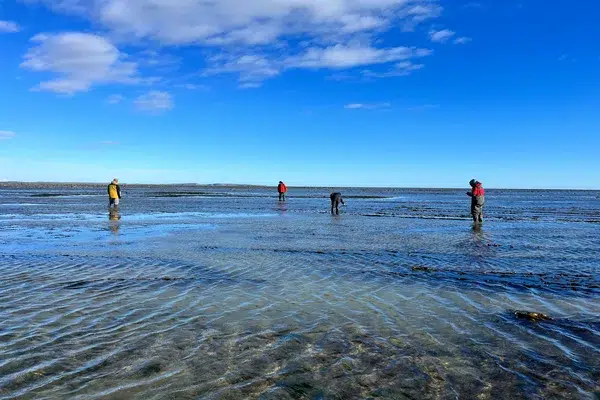
The so-called “ghost forests” develop in the intertidal zone, where the landscape changes constantly according to the rhythm of the tides. Consequently, these environments appear and disappear throughout the day.
During low tide, the algae structures are exposed, while at high tide they are completely submerged. For this reason, their ephemeral nature gives them a “ghostly” appearance that inspires their name.
Likewise, researchers detected that the greatest biodiversity is not visible at first glance. In fact, under rocks and surfaces hide organisms such as starfish, snails, octopuses, and small crustaceans.
On the other hand, when the water returns, more mobile species such as sharks and rays are added. Consequently, the system functions as a highly dynamic environment, where multiple ecological interactions develop continuously.
Hidden biodiversity and ecological functions
These forests play an essential role as a refuge, food source, and breeding area for numerous species. Indeed, they act as true “hotspots” of biodiversity in variable environmental conditions.
Moreover, their complex structure favors protection against predators and extreme conditions. Therefore, they contribute to the stability of marine communities in a changing environment.
However, globally, many kelp forests are in decline. In contrast, those present in Tierra del Fuego remain relatively conserved, which increases their scientific and ecological value.

What ghost forests are and why they matter
Ghost forests are formations of macroalgae that inhabit intertidal zones and become exposed or submerged depending on the tides. Consequently, they present unique adaptive characteristics.
Among their main features, their high biological productivity, their ability to harbor multiple species, and their role as indicators of environmental changes stand out. Therefore, their study allows for anticipating impacts of climate change.
Additionally, these ecosystems contribute to processes such as carbon capture and nutrient regulation in the sea. Thus, their conservation is key to the health of the oceans.
Conservation and future challenges
In Tierra del Fuego, the protection of these environments is contemplated in current legislation, such as law 1589, which regulates their sustainable management. However, specialists warn that much remains to be investigated.
In this sense, the generation of scientific knowledge presents itself as an essential tool for designing effective conservation strategies. Additionally, collaboration with local communities strengthens the environmental commitment.
Finally, these ecosystems emerge as sentinels of global change. Therefore, understanding their functioning not only allows for protecting marine biodiversity but also anticipating transformations in the ecological balance of the planet.


