



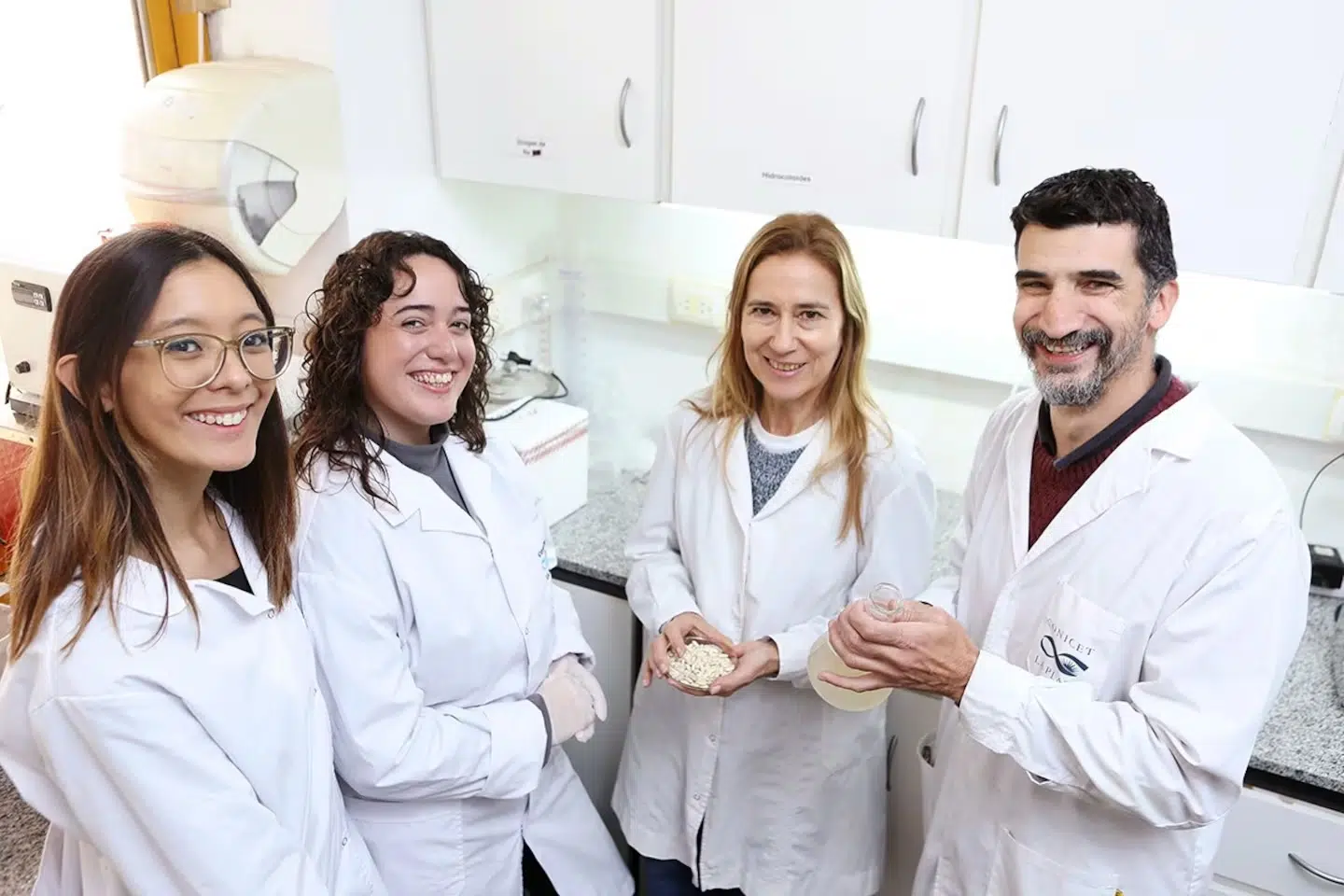
Specialists from the CONICET, together with researchers from the UNLP and the Scientific Research Commission of Buenos Aires, are promoting a circular economy project that utilizes aquafaba, the liquid resulting from cooking legumes, to reduce waste and generate sustainable alternatives.
The initiative has already led to the design of a vegan egg alternative and is now moving towards the development of bioplastics, demonstrating how a by-product can become a key input for the food and environmental industry.
Properties of Aquafaba
Aquafaba contains proteins, fibers, carbohydrates, and minerals, without altering the properties of the final products. Its use offers:
- Nutritional solution suitable for people with intolerances.
- Cruelty-free product, ideal for vegan recipes.
- Technological versatility, as it can be transformed into powder through spray drying.
This process allows the liquid to be dehydrated and turned into a functional powder that can replace eggs in various preparations.
Public-Private Collaboration
The project was supported by Grupo L, an Argentine company that distributes more than a million food rations in 15 provinces. According to researcher María Eugenia Golzi, the project leader, the challenge is to promote an industry capable of drying aquafaba at the source, increasing its stability and reducing storage and transportation infrastructure.
The proposal could be replicated in large food service companies, integrating sustainability from the very production process.
Global Context
According to the FAO, about 14% of the food produced in the world is lost before reaching the market. In industrial production, by-products like whey, peels, and pulps represent million-dollar losses. The cooking water of legumes, traditionally discarded, now appears as an input with excellent functional and technological properties.
Bioplastics with Aquafaba
The research group has advanced in using aquafaba to produce bioplastics, combining it with lentil flour. These materials could be used for food packaging, offering:
- Sustainable alternative to traditional polymers.
- Lower environmental impact at the time of final disposal.
- Food safety, by reducing the risks of ingesting microplastics.
This advancement is part of Golzi’s doctoral thesis and opens new possibilities for the sustainable packaging industry.
Impact and Projection
The continuation of the project reflects how the collaboration between science, university, and the private sector can generate tangible solutions to:
- Improve the nutritional contribution of food.
- Reduce the environmental footprint of the industry.
- Add value to production through technological innovation.
The utilization of aquafaba is an example of how the circular economy can transform waste into strategic resources.
From egg substitution to the creation of bioplastics, this CONICET project demonstrates that sustainability and innovation can arise from the everyday and become drivers of change for the food and environmental industry.



