



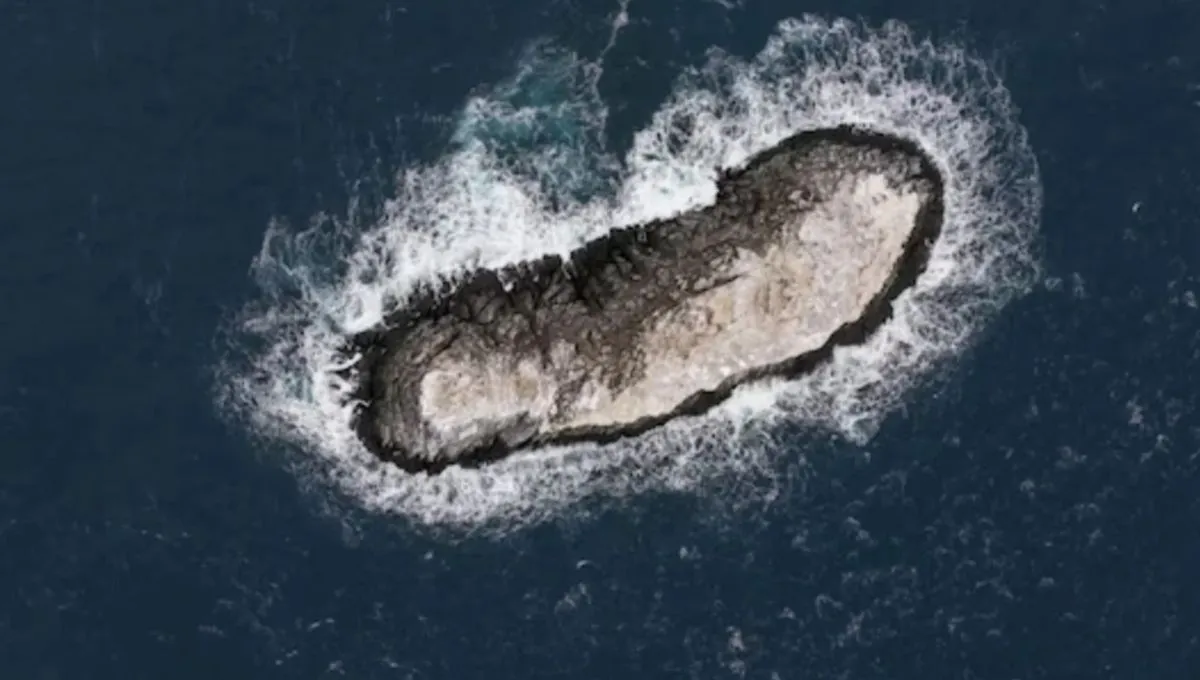
An international team of scientists discovered in 2026 an unknown island in the Weddell Sea during an expedition aboard the German icebreaker Polarstern, coordinated by the Alfred Wegener Institute for Polar and Marine Research. The rocky formation was identified when the vessel sought refuge from bad weather near Joinville Island.
What appeared to be an iceberg turned out to be a solid, dark structure emerging from the sea. Preliminary measurements indicate that the island is 130 meters long, 50 meters wide, and 16 meters high above water level. Although small, its scientific relevance is considerable.
A Critical Zone
The region was already marked on nautical charts as a “danger sector,” but without precise description. This suggests that the island may have remained hidden under ice shelves or floating glacier masses for decades. Another hypothesis points to calving processes that may have exposed a previously submerged rocky base.
The discovery comes in a context of growing concern about the stability of the Antarctic system. In recent decades, changes have been recorded in the extent of sea ice and the behavior of glacier platforms.
Scientific Relevance
The Weddell Sea is key to the formation of deep waters that influence global ocean circulation. Changes in this region can have planetary impacts, from climate to marine ecosystems. Although it is still premature to directly link the appearance of the island with climate change, its exposure could be related to modifications in ice dynamics.
The Polarstern, considered one of the most advanced scientific platforms for polar study, conducts research in sea ice physics, ocean biogeochemistry, and the interaction between atmosphere and ocean. The discovery of the island adds to a series of observations aimed at understanding how polar landscapes evolve in the face of environmental changes.
Next Steps
The researchers plan to:
- Accurately map the area.
- Analyze the geological composition of the island to determine its origin and age.
- Evaluate its relationship with other underwater structures.
- Consider its impact on Antarctic navigation, as it confirms that there are still elements not recorded on nautical charts.
The discovery of this island in the Weddell Sea demonstrates that Antarctica remains a territory full of mysteries. Each new observation provides key pieces to understand the evolution of ice and geological processes and reminds us that changes in these regions can have repercussions across the planet.



