



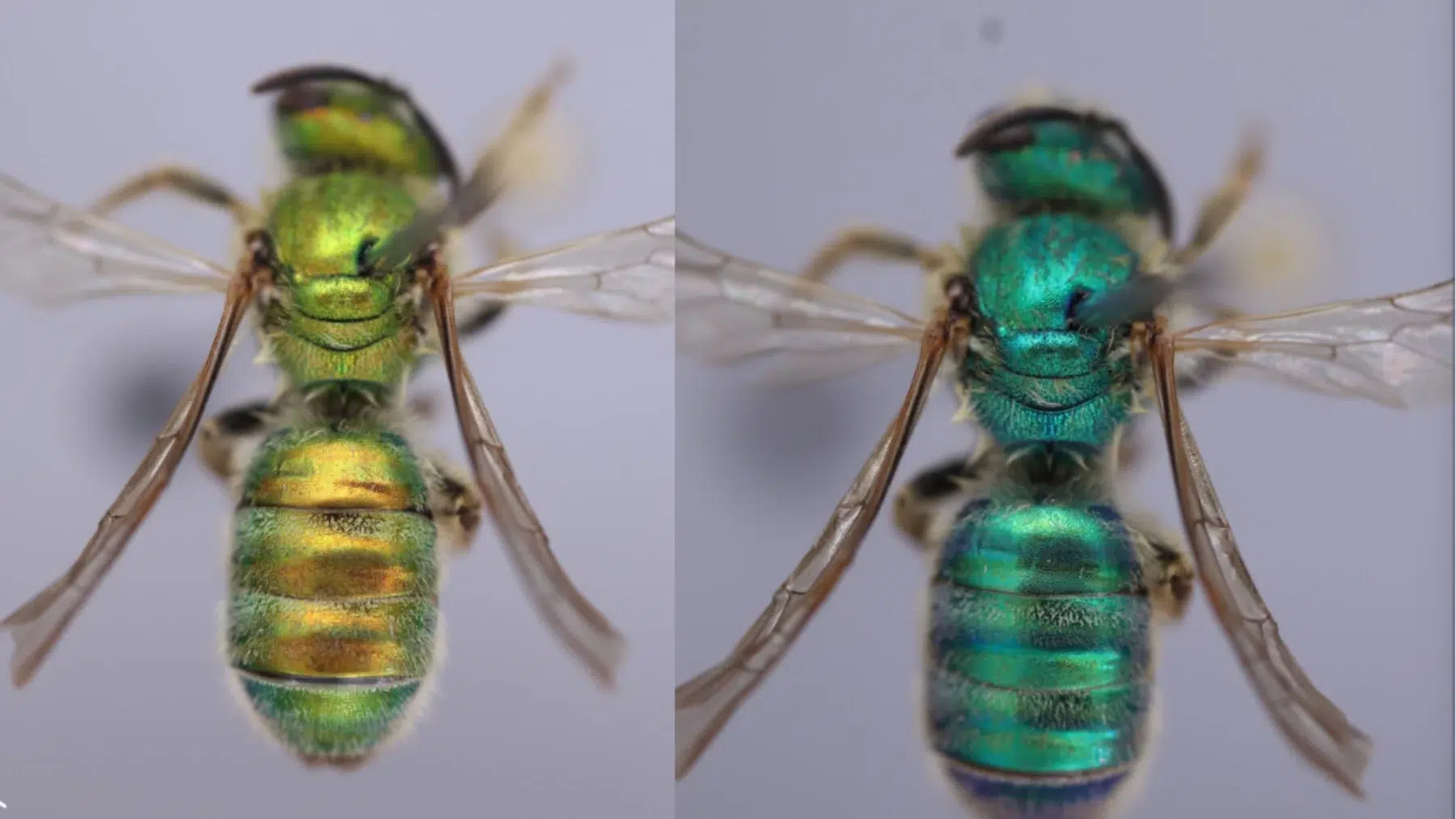
A study led by ecologist Madeleine Ostwald from Queen Mary University of London revealed that sweat bees of the genus Agapostemon possess an extraordinary ability: they change color according to air humidity. In dry environments, they turn intense blue, while with humidity close to 95%, they acquire green or coppery tones.
This change does not depend on pigments but on microscopic structures in their exoskeleton that reflect light differently when absorbing water. The phenomenon is reminiscent of the mechanism of chameleons, although in bees it occurs automatically, without conscious control.
Distribution and Observations
Bees of the genus Agapostemon live exclusively in America, from Canada to Argentina, with greater presence in the United States and Mexico. Researchers analyzed populations from the west coast of North America and used over a thousand photographs from the iNaturalist application to confirm the phenomenon in natural conditions.
Specimens in dry areas appeared more blue, while those in humid areas showed green colors. Additionally, when studying specimens preserved in museums, it was observed that older ones changed color more intensely, probably due to the wear of the exoskeleton that facilitates the entry of moisture.
Ecological and Agricultural Role
The sweat bees are fundamental native pollinators:
- Cross-pollination: they mobilize vital genetic material for biodiversity.
- Effectiveness in crops: they sometimes surpass the European honeybee in pollinating native plants.
- Primitive sociality: they build nests in sandy soils and share entrances to protect against parasites.
- Bioindicators: their presence reflects the health of local ecosystems.
They are frequently observed in daisies, sunflowers, lavender, rosemary, and sage, as well as in orchards and urban gardens, where they contribute to the reproduction of native flora and agricultural crops.
Main Characteristics
- Visual identification: shiny metallic bodies, with green or coppery abdomen.
- Behavior: solitary or communal insects, harmless to people.
- Attraction to human sweat: they seek mineral salts on the skin, which gave them their popular name.
Implications of the Discovery
Scientists are still investigating whether the color change influences:
- Body temperature: possible thermal regulation.
- Camouflage: adaptation against predators.
- Communication: visual signals between individuals.
This discovery opens new lines of research on how insects respond to environmental variability and how these adaptations can influence ecosystem resilience in the face of climate change.
Agapostemon bees not only surprise with their metallic colors but also with their ability to change hue according to humidity. This phenomenon reinforces their role as environmental indicators and essential pollinators for American biodiversity. Conserving them means protecting a vital cog in ecosystems and local agriculture.


