



After the success of the Talud Continental IV campaign, which thrilled millions of people with live broadcasts from the ocean floor, the Deep Sea Studies Group of Argentina (GEMPA) is preparing for a new expedition: Talud Continental V.
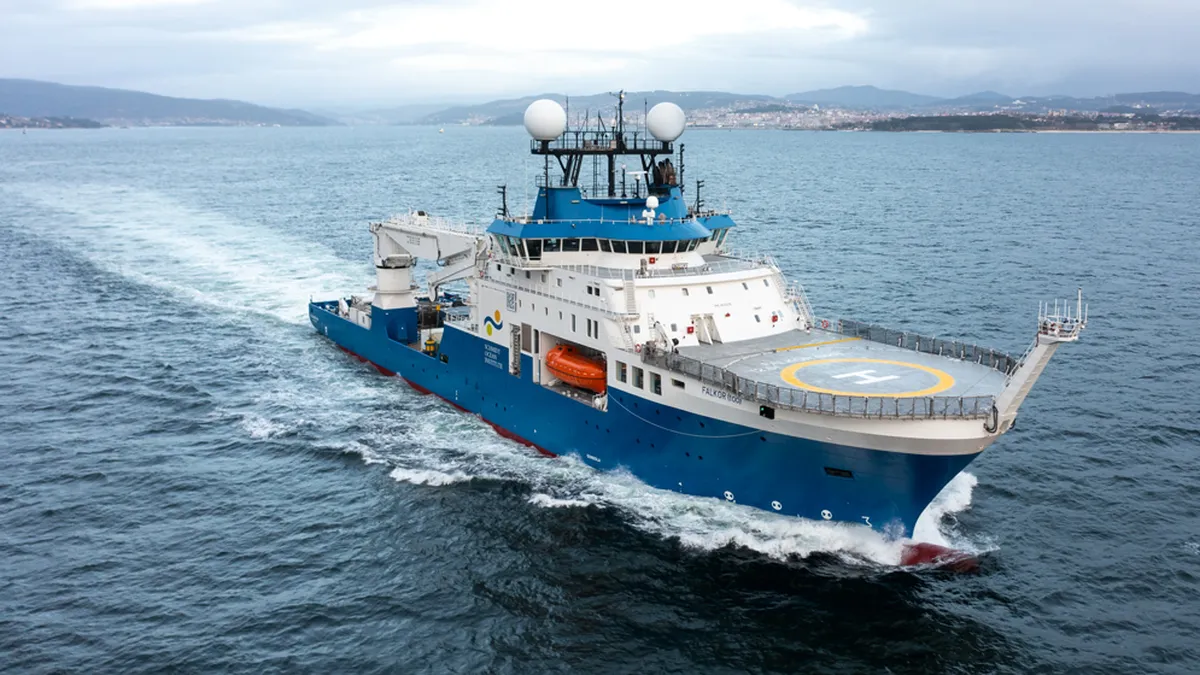
This mission will be conducted aboard the Falkor (too) vessel from the Schmidt Ocean Institute, aiming to explore the Ameghino and Almirante Brown canyons, located off the coast of Chubut province, about 600 km from the shore.
The expedition will last 23 days and is scheduled for April 2027, although there is a possibility of moving it up to February. It is a little-explored region of the Southwestern Atlantic, with high biodiversity potential and the presence of vulnerable marine ecosystems.
Scientific Objectives
GEMPA’s multidisciplinary team will address multiple lines of research:
- Deep-sea biodiversity: study of invertebrates and fish.
- Cold-water coral reefs and vulnerable habitats.
- Environmental DNA (eDNA) to analyze biological connectivity.
- Oceanographic processes and sediment dynamics.
- Human impact on remote environments, including microplastics.
One of the central objectives will be to explore depths greater than 4,000 meters, expanding the range reached in previous campaigns and accessing environments never studied in Argentina.
Open Science and Social Participation
The previous campaign marked a milestone in public science communication: millions of people followed live broadcasts from the ocean floor. Talud Continental V will repeat and expand this experience with:
- Live broadcasts of the ROV SuBastian dives.
- Real-time educational activities with schools across the country.
- Open data publication in national and international repositories.
“We are very excited to be able to share again with people the diversity of deep-sea fauna that inhabits our country,” expressed Daniel Lauretta, the scientific leader of the campaigns.
Impact of Talud Continental IV
Between July and August 2025, the Talud Continental IV expedition explored the Mar del Plata canyon and documented:
- Cold-water coral reefs.
- Extensive fields of soft corals.
- More than 40 potentially new species to science.
The impact was enormous: millions of views on live broadcasts, bringing scientific exploration closer to society and consolidating a model of open science with strong public participation.
Strategic Importance for Argentina
Argentina has more than one million km² of marine surface, one of the richest and most productive regions in the world. Studying the deep ocean allows us to understand:
- How these ecosystems function.
- What species inhabit them and how they connect with other environments.
- Their role in global processes such as the carbon cycle and climate regulation.
Collaboration with the Schmidt Ocean Institute has been key, not only for access to international-level technology but also for the collaborative and open science work model.
Expectations in the Ameghino and Almirante Brown Canyons
Submarine canyons are considered globally as zones of high biodiversity. According to Lauretta, “the deep zone of these canyons has not been studied from a biological perspective to date, so it will be the first time we can see and analyze this fauna.” The team expects to find both species already seen in the Mar del Plata canyon and others completely new.
The Talud Continental V mission consolidates CONICET’s role in deep ocean exploration and represents a unique opportunity to discover new biodiversity, generate key information for conservation, and strengthen the link between science and society.
Each expedition not only expands scientific knowledge but also inspires the public and demonstrates that international cooperation is essential to face the environmental challenges of the 21st century.



