



In August 2024, the fires in the Bolivian Chiquitania separated Yaguara, a young jaguar, from her mother. The cub escaped the fire and arrived at a ranch in Ascensión de Guarayos, Santa Cruz, where she was rescued by the organization Comunidad Inti Wara Yassi (CIWY).
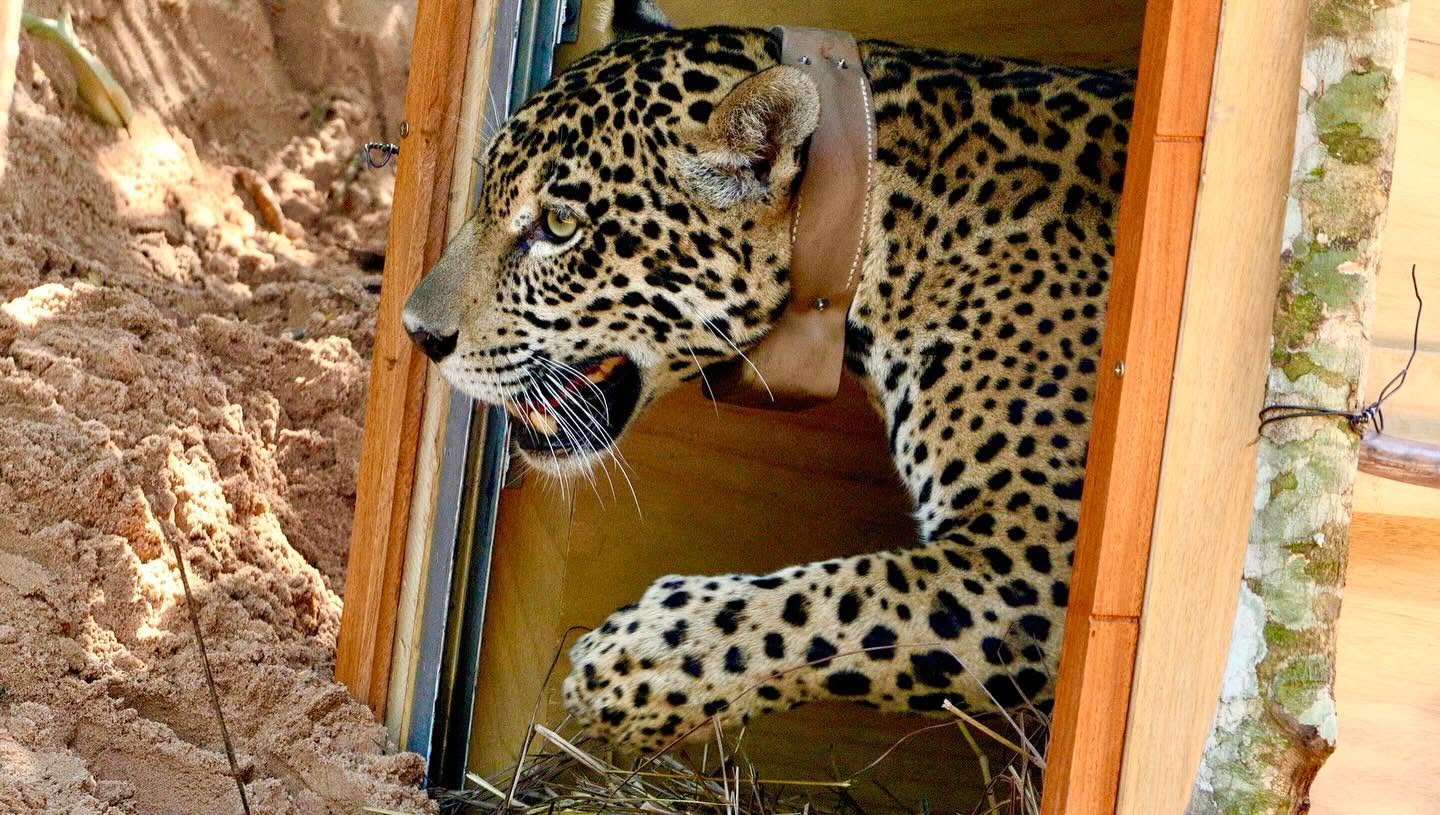
After almost two years of rehabilitation at the Ambue Ari refuge, Yaguara was reintroduced into the Noel Kempff Mercado National Park, marking a historic milestone for the conservation of big cats in Bolivia.
The rehabilitation process
Yaguara’s preparation included:
- A 10,000 m² enclosure designed to replicate her natural habitat, with vegetation, refuge areas, and an artificial lagoon.
- Camera traps to monitor her behavior without human intervention.
- Introduction of natural prey to exercise her hunting skills.
- Technical protocols and permits from the General Directorate of Biodiversity.
The goal was to ensure that the jaguar regained the necessary skills to survive alone in the jungle.
A pioneering release
The logistics were complex: Yaguara traveled by vehicle, small plane, and boat to reach the deep areas of Noel Kempff Mercado. “It was a day full of incredible emotions. After so much effort, we managed to release the first rehabilitated jaguar in Bolivia,” celebrated Tania Baltazar, president of CIWY.
The National Service of Protected Areas (Sernap) confirmed the successful release and highlighted that the process strengthened the country’s technical capacities for wildlife rehabilitation.
Monitoring with technology
Yaguara now wears a satellite collar that will allow tracking her movements and adaptation.
This pioneering system in Bolivia will provide valuable information for the conservation of the jaguar and other big cats.
Interinstitutional work
The project had the support of:
- Friends of Nature Foundation (FAN).
- Foundation for the Conservation of the Chiquitano Forest (FCBC).
- Fundesnap.
- Quebracho Firefighters.
Additionally, an Interinstitutional Technical Committee was formed to evaluate each stage of the process, from rescue to release.
Importance for conservation
Yaguara’s case demonstrates that it is possible to rescue and return big cats affected by fires and habitat loss to nature. Bolivia thus establishes protocols and capacities that can be applied in future cases.
The experience also reinforces the need to protect the Amazonian and Chiquitano ecosystems, increasingly threatened by fire and deforestation.
Yaguara’s reintegration marks a historic milestone: she is the first rehabilitated and released jaguar in Bolivia. Her story symbolizes hope for the conservation of the species and paves the way for other big cats to return to freedom.
Source: Mongabay


