



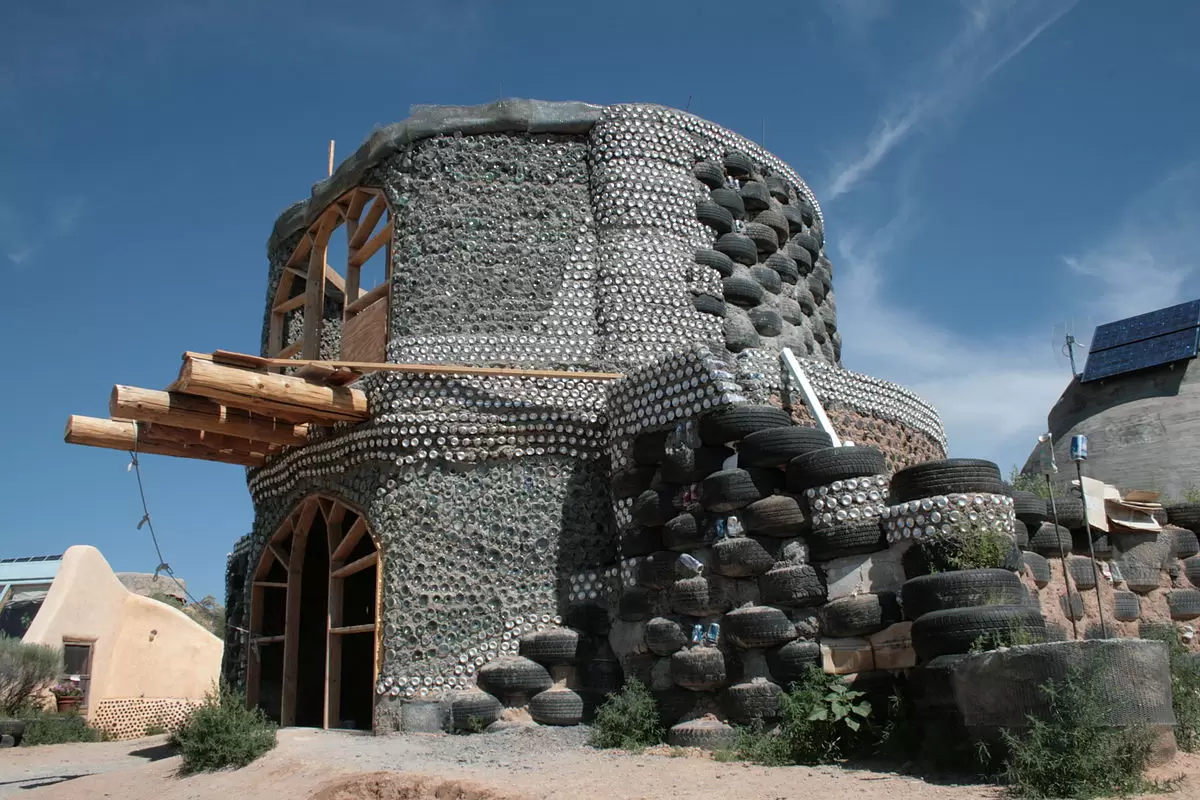
The Earthships are sustainable houses created by the American architect Michael Reynolds in the 1970s. His most emblematic project is located in Taos, New Mexico, where dozens of houses have been built following this model.
These constructions are characterized by using recycled materials such as tires, cans, and bottles, transforming waste into durable and efficient structures.
How they work
- Tire walls filled with earth: each tire, compacted to exceed 100 kg, is stacked like a giant brick, forming thick walls that store heat during the day and release it slowly at night.
- Passive solar design: the main facade incorporates a glazed greenhouse that captures the sun’s energy.
- Thermal mass: regulates the interior temperature, keeping it stable around 20 °C all year round, even with snow or extreme heat outside.
- Renewable energies: solar panels, rainwater harvesting, and passive climate systems minimize the use of heating or air conditioning.
Main benefits
- Ecological: prevents millions of tires from ending up in landfills or polluting the environment.
- Natural insulator: works like a thermos, keeping warmth in winter and coolness in summer.
- High resistance: absorbs impacts, being safe against earthquakes.
- Retaining walls: useful for holding back earth on slopes and preventing landslides.
Construction method
- Filling: each tire is filled with earth.
- Compaction: it is pounded until it exceeds 100 kg.
- Stacking: they are placed like giant bricks, tied together.
- Coating: they are covered with mud or clay to protect them from the sun and prevent gas emissions.
Innovation beyond housing
Recycled rubber is also used in:
- Flexible roads: mixed with asphalt, reduces cracks and traffic noise.
- Light and resistant concrete: improves the durability of constructions.
- Acoustic walls: tire dust is used to create noise barriers.
Advantages of tire recycling
- Energy saving: manufacturing tires with recycled material reduces oil use by 50%.
- Less waste: tires take centuries to degrade; recycling them saves landfill space.
- Health protection: prevents the accumulation of stagnant water that favors mosquitoes and diseases.
- New products: rubber and steel are reused in sports tracks, shoe soles, and more.
A model for the future
Earthships represent a paradigm shift in architecture: homes that do not rely on conventional energy systems and integrate sustainability into their design. In a context of climate crisis, this type of construction offers practical solutions to reduce the carbon footprint and take advantage of local resources.
Furthermore, their replication in different parts of the world demonstrates that it is possible to adapt the model to different climates and cultures. From deserts to snowy regions, tire houses maintain stable temperatures and reduce energy costs, becoming a viable alternative for communities seeking energy independence and environmental resilience.
Houses built with tires are an example of how to transform waste into sustainable solutions. Their ability to maintain stable temperatures, reduce energy consumption, and utilize recycled materials makes them a model of resilient architecture in the face of climate change.


