



Between 1946 and 1990, more than 200,000 barrels with radioactive waste were deliberately dumped at the bottom of the Atlantic Ocean. Sealed in cement or bitumen, they have remained for almost 80 years in abyssal plains more than 4,000 meters deep, about 600 km off the coast of Nantes.
Today, an international scientific mission led by France is attempting to locate these containers and assess their condition, as part of the NODSSUM project, driven by the CNRS, Ifremer, the Nuclear Safety and Radioprotection Authority (ASNR) and international partners.
Mapping and Initial Dives
The first phase, initiated in June 2025, mapped an area of 6,000 km² with high-resolution sonar and the autonomous vehicle UlyX. Samples of water, sediments, and marine fauna were collected to analyze the presence of radionuclides.
Preliminary results detected slight radioactive contamination, comparable to areas already affected in French territory. This led to a more focused second stage, with descents in the submersible Nautile.
During the dives, scientists directly observed the barrels and found an unexpected fact: life around the containers. Some had organisms attached, evidence of colonization in contaminated environments.
Visual Contradictions
Marine geologist Javier Escartín described the scene as a paradox: “There is a strange and incongruent beauty in the barrels, which represent human-caused pollution”.
Additionally, the mission detected another persistent problem: human trash in remote areas of the deep ocean.
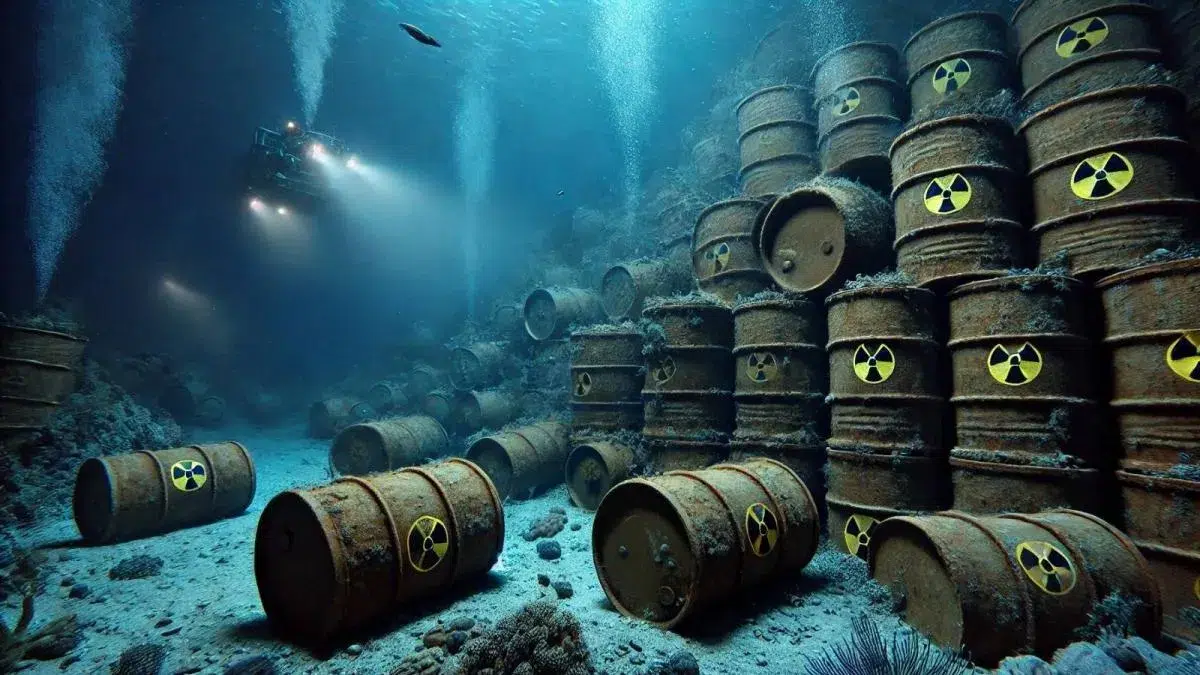
Condition of the Containers
- Metal Corrosion: saltwater oxidizes and destroys steel.
- Cracks in Cement: the binding material fractures under extreme pressure.
- Slow Leaks: previous expeditions detected the release of harmful material.
Impact on the Marine Ecosystem
- Abyssal Fauna: organisms directly exposed to radiation.
- Genetic Alteration: cellular damage and mutations in little-studied species.
- Food Chain: contaminants bioaccumulated in filter organisms can escalate to higher levels.
PRIME RADIOCEAN Initiative
The NODSSUM project is part of the PRIME RADIOCEAN initiative, which seeks to understand the risks of nuclear waste in the marine environment and design safer and more sustainable management policies.
The data collected will help decide whether it is safer to remove the disintegrated barrels or leave them confined to avoid stirring up contamination.
The research led by France marks a crucial advance in evaluating past nuclear practices and protecting deep ecosystems.
Although the barrels represent a latent threat, they also reveal life’s ability to adapt in extreme conditions, reminding us of the urgency to design management policies that prioritize environmental safety and planetary balance.



