



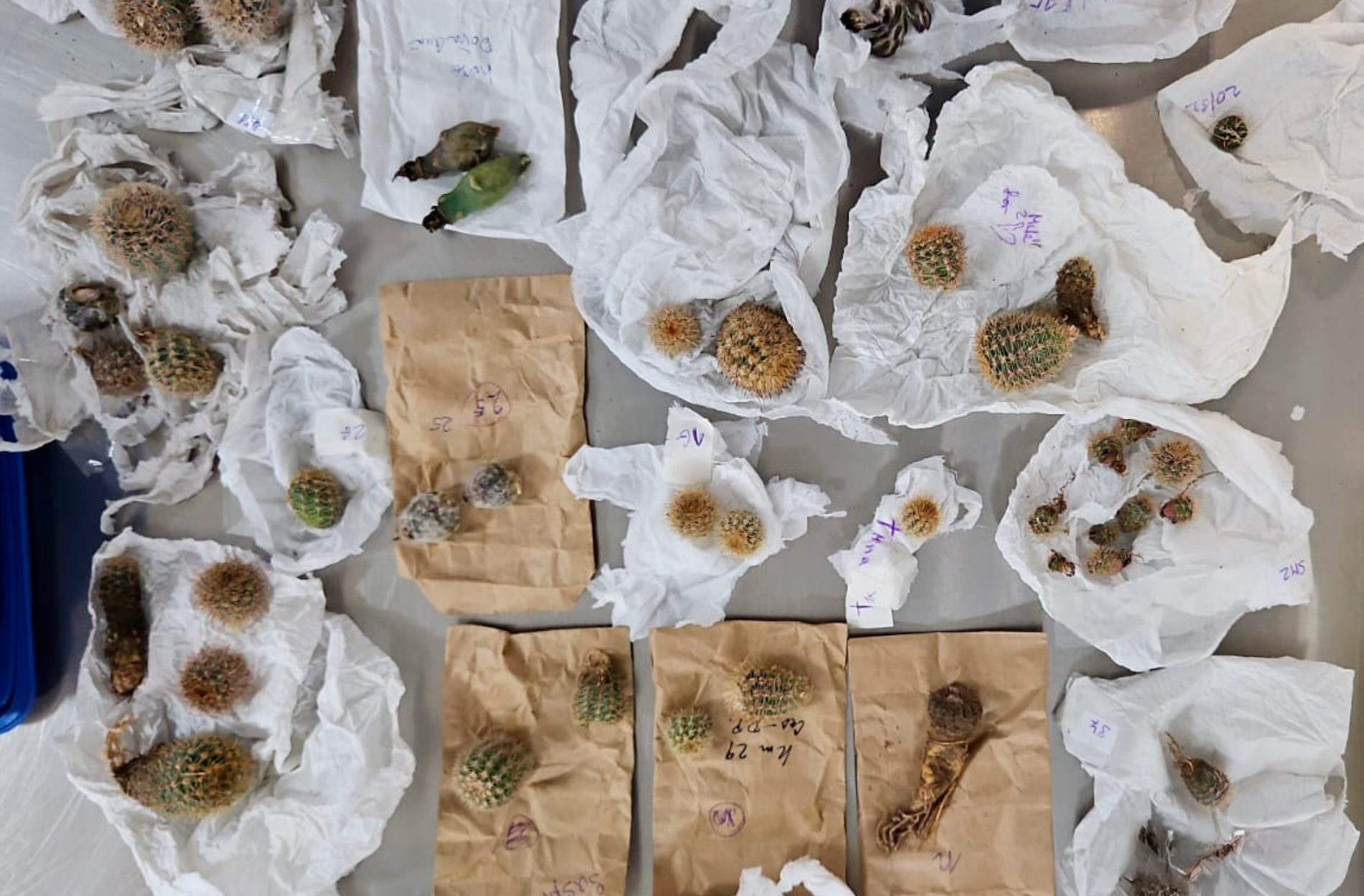
The Federal Police of Brazil intercepted four Czech citizens in February at the Guarulhos International Airport, São Paulo, with 214 specimens of cacti and seeds hidden in beer cans, paper bags, and even shoes.
The plants belonged to seven native species from Rio Grande do Sul, two of them critically endangered: Parodia nothorauschii and Parodia neohorstii.
In March, a German couple was detained at the Salgado Filho Airport in Porto Alegre with seedlings and seeds of the Frailea genus. IBAMA fined them 148,000 reais (29,000 dollars) for transporting genetic heritage without authorization.
In 2024, Russian Alexey Filippov was caught collecting cacti in the Espinilho State Park. He carried 98 samples and was accused of smuggling and trespassing in a protected area.
Profile of those involved
The Czech and German citizens are part of international groups of cactus enthusiasts:
- Jaroslav Vich: former president of the Czech-Slovak Society of Cactus Growers.
- Karel Slajs: collected cacti in Mexico in the 2000s.
- Vladimir Sorma: offered seeds on social networks.
- Jörg Andreas Hofacker: former president of the German Cactus Society, with species named in his honor (Parodia hofackeriana).
All of them have a background in collecting and specialized publications, reinforcing the hypothesis of organized biopiracy.
Environmental impact
The illegal extraction of cacti poses a serious threat:
- Loss of biodiversity: of the 70 species recorded in Rio Grande do Sul, 52 are threatened and 14 are endemic.
- Risk of extinction: each extracted plant reduces already vulnerable populations; some take up to 10 years to reach reproductive maturity.
- Ecological disruption: mass extraction affects natural regeneration and the stability of arid ecosystems.
Legal framework and international treaties
The species are protected by the CITES Convention, which regulates the trade of wild fauna and flora. To export them, authorization from IBAMA is required, certifying that the transaction does not compromise the species’ survival.
Additionally, the Brazilian Biodiversity Law establishes penalties for the illegal extraction and export of genetic heritage. The accused face charges of smuggling and environmental crimes.
Institutional perspective
Brazilian authorities point out that biopiracy is a recurring and difficult-to-control crime due to the country’s extensive border. Mariela Inês Secchi, from the Rio Grande do Sul Environmental Secretariat, described it as a “colonial mentality,” where foreigners believe they can take natural resources without authorization.
The recent cases in Brazil highlight how biopiracy threatens unique and endangered species. The illegal extraction of cacti not only violates national and international legislation but also compromises the conservation of fragile ecosystems.
The institutional response seeks to strengthen controls and sanctions, but the pressure from collectors and international markets remains a challenge for biodiversity protection.



