



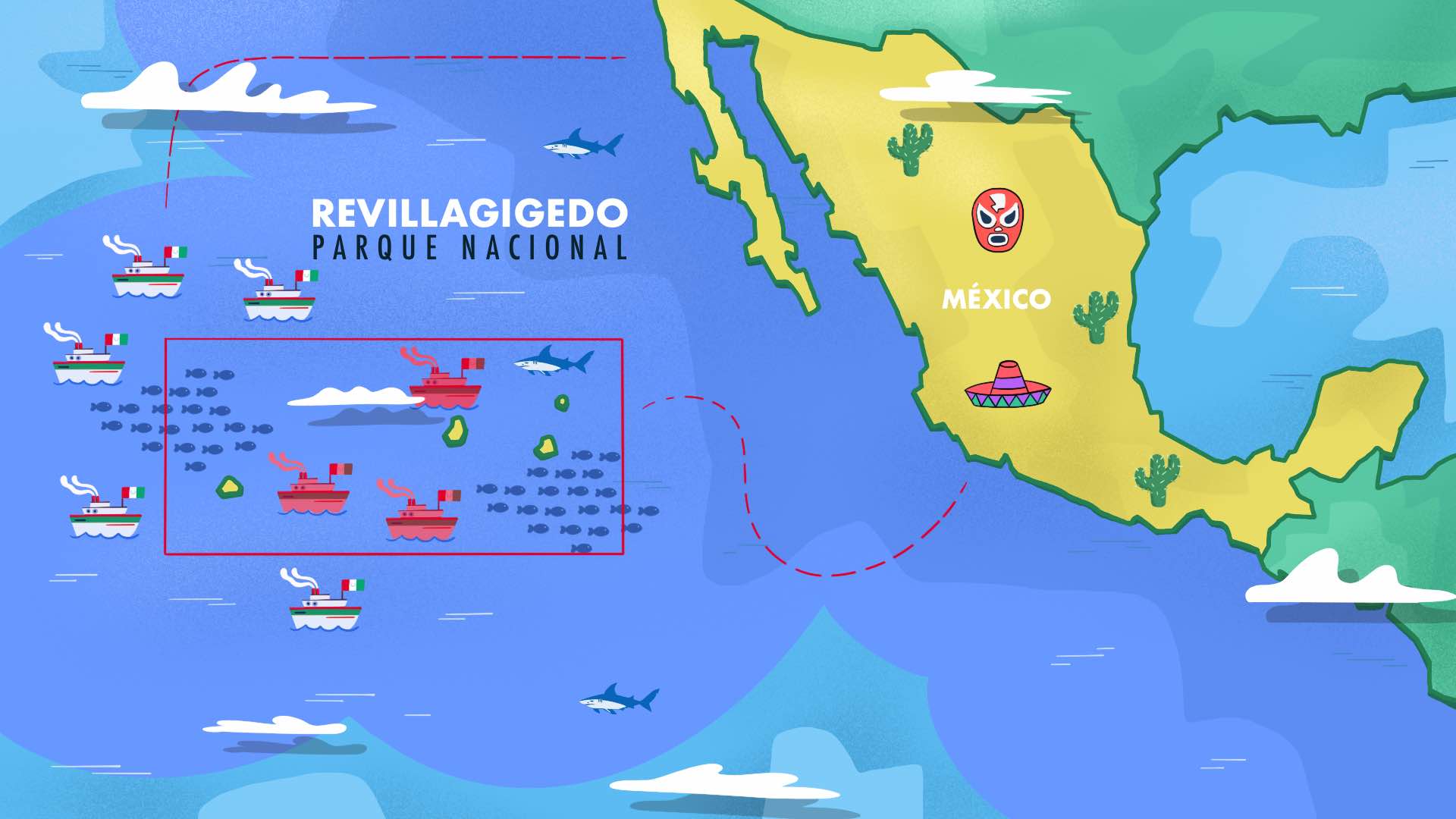
Mexico has made a groundbreaking decision to protect the Archipiélago de Revillagigedo. It is the largest region in North America (148 square kilometers) that has been declared a Marine National Park.
The archipelago is made up of four islands, called Clarión, Socorro, San Benedicto, and Roca Partida, located about 660 kilometers from the Port of Manzanillo in the state of Colima and 320 kilometers from Los Cabos in Baja California Sur.
It is an area where fishing activities have interfered to the detriment of its healthy growth.
Importance and conservation of the Revillagigedo archipelago
“Revillagigedo proves to be an area where we still observe large schools of species such as sharks, groupers, jacks, tunas, which represent a reservoir of marine life that nourishes the rest of the Pacific. The intention to ban fishing is to lock it up for the future,” explains María José Villanueva, director of conservation at the World Wildlife Fund.
Revillagigedo is one of the most pristine ecosystems in the Mexican Pacific, hosting some of the largest aggregations of marine fauna in the world, including various species protected by Mexican legislation such as the humpback whale and the whale shark.
Its main threats are overfishing and incidental capture of species, as well as unregulated recreational activities. In July 2016, UNESCO included Revillagigedo on its World Heritage List for its excellent state of conservation.
A sustainable future for biodiversity
This substantial place is described as “a natural laboratory,” where processes of colonization, dispersion, and adaptation of marine and terrestrial fauna are observed. The idea, of course, is to conserve this essential site for biodiversity and the health of the Pacific Ocean.
“Island areas are breeding, refuge, and stopover sites for hundreds of local and migratory species, so their protection is of enormous importance for the health of ecosystems and fisheries,” argues the same UNESCO site.
Challenges and commitments for protection
Certainly, declaring this area a protection zone is one thing, but having a robust conservation management program for the new Marine National Park, adequate funding, constant support from staff, and the necessary equipment to operate effectively is another.
It must remain an area where marine species have a place to withstand changes in the oceans.
By protecting this area, Mexico has taken a very important step in the effort to combat climate change, as the region’s fauna and flora will have the opportunity to heal, revive, and grow healthily.
Have you visited our YouTube channel yet? Subscribe now!



