



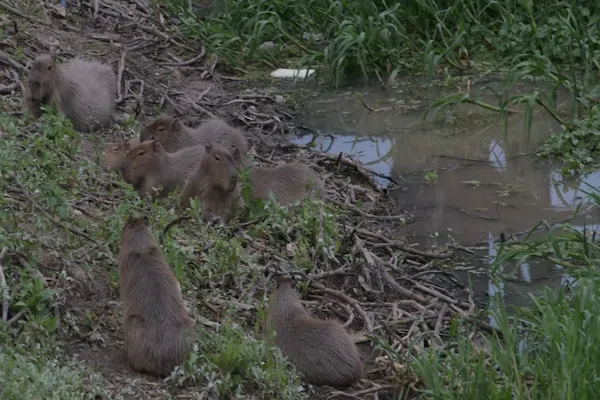
With the installation of new signage in the area, the provincial government launched a campaign to protect the carpinchos from the port of Santa Fe. A family of these animals lives there, and the goal is for them to coexist without problems with the people who frequent the area.
These carpinchos or capybaras, which are often seen near Dique 2, have generated great interest among visitors. Therefore, it is essential that people know how to take care of wildlife and not scare or harm them.
Responsible coexistence: the keys of the campaign for carpinchos in Santa Fe
Although they are sociable animals, authorities urge the population to keep their distance and not feed them. This measure is crucial for their well-being and for a safe coexistence between humans and wildlife. The Santa Fe Port Administration Agency highlighted that the presence of these animals is a sign of the area’s environmental commitment.

Both the port authority and the Ministry of Environment and Climate Change of the province emphasized the importance of citizen cooperation. They ensure that the conservation of these animals is not only the task of institutions but a collective effort of society.
According to their statements, coexisting with local wildlife requires the participation of the entire society, including neighbors, schools, companies, tourists, and every resident of Santa Fe who visits the port.
The presence of wild fauna in urban areas reflects the health of the ecosystem and provides an opportunity to reflect on our relationship with the natural environment.
The islands of Santa Fe, part of the alluvial valley of the Paraná River, are a vital ecosystem with immense biodiversity. Protecting it is essential to maintain balance and ensure the survival of all species, including our own.
The arrival of carpinchos at the port of Santa Fe
At the end of last year, a small group of carpinchos was spotted at Dique II of the Port of Santa Fe. The animals were on the west bank, in an area that is currently unused. The abundant vegetation makes the habitat ideal for them to seek shelter and food.
The striking fact was finding the carpinchos in a zone that has been urbanized in recent years, as part of the port’s land use renewal plan, just meters from the city center.
“Just as they appeared in the port, they also appeared in other areas of the city,” explained Alba Imhof, a Biodiversity expert from the Faculty of Humanities and Sciences of the National University of the Litoral (FHUC UNL), to the Agencia Fe at that time.
“We have our own experience at the University City. Nowadays, students go to class, spend some time taking a break at the back of the reserve, and see the carpinchos; we even have records of copulation,” she added.



