



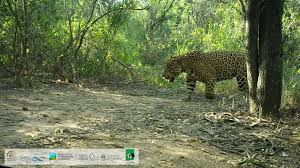
The ninth jaguar registered in one of the conservation corridors of Formosa already has a name. More than 1,700 people participated in the voting to baptize it, choosing “Chalak,” which in the qom language means courage.
This specimen, previously identified as M9, was first captured on camera traps, sparking the interest and commitment of local communities, organizations, and researchers working for the preservation of the great Chaco feline.
The voting campaign offered four options with strong cultural and natural roots: Kates (star, in wichí), Ñeegawa (friend, in pilagá), Chalak (courage, in qom), and Bañado (allusive to the wetland). More than a thousand votes supported the name that currently accompanies its story.
As a conclusion to the initiative, an informative kit about the jaguar and its habitat was raffled among participants to continue strengthening knowledge and commitment to its protection.
## Monitoring and Community Work
In the Chaco region, eleven male jaguars have been identified so far, six of them in Formosa. The registration of Chalak was possible thanks to monitoring with camera traps coordinated by the Yaguareté Project (CeIBA – CONICET), in collaboration with the Subsecretaría de Recursos Naturales, the Ministerio de Producción y Ambiente, and with the support of Fundación Vida Silvestre Argentina and other allies.
This control system is the result of the joint work of park rangers, technicians, researchers, communities, and volunteers. Involving those who coexist with the jaguar in their territory promotes coexistence and helps prevent conflicts, reinforcing empathy towards this key species.
Each sighting and every piece of data collected feed a presence map that allows for more effective conservation actions to be planned and the population’s health in the region to be evaluated.
Chalak’s story is not just that of an animal but also of a networked work that seeks to ensure that the jaguar’s roar continues to resonate in the forests of the Gran Chaco.

## Conservation Status of the Jaguar
The jaguar (Panthera onca) is the largest feline in America and a top predator in the food chain, making it an essential piece for maintaining the balance of ecosystems.
In Argentina, the species is critically endangered. It is estimated that fewer than 250 individuals remain, and in the Gran Chaco, its population does not exceed 20 specimens. This drastic reduction is due to habitat loss and fragmentation, poaching, and the decrease in its natural prey.
Its protection is guaranteed by national and provincial laws that declare it a Natural Monument, prohibiting its hunting and promoting the conservation of its territories. Protecting the jaguar also means safeguarding large areas of native forest, vital for biodiversity and for human communities depending on these ecosystems.
Chalak’s presence is an encouraging sign amidst a complex panorama. Each new registration fuels hope of recovering a healthy population and returning one of the most powerful symbols to the Gran Chaco.


