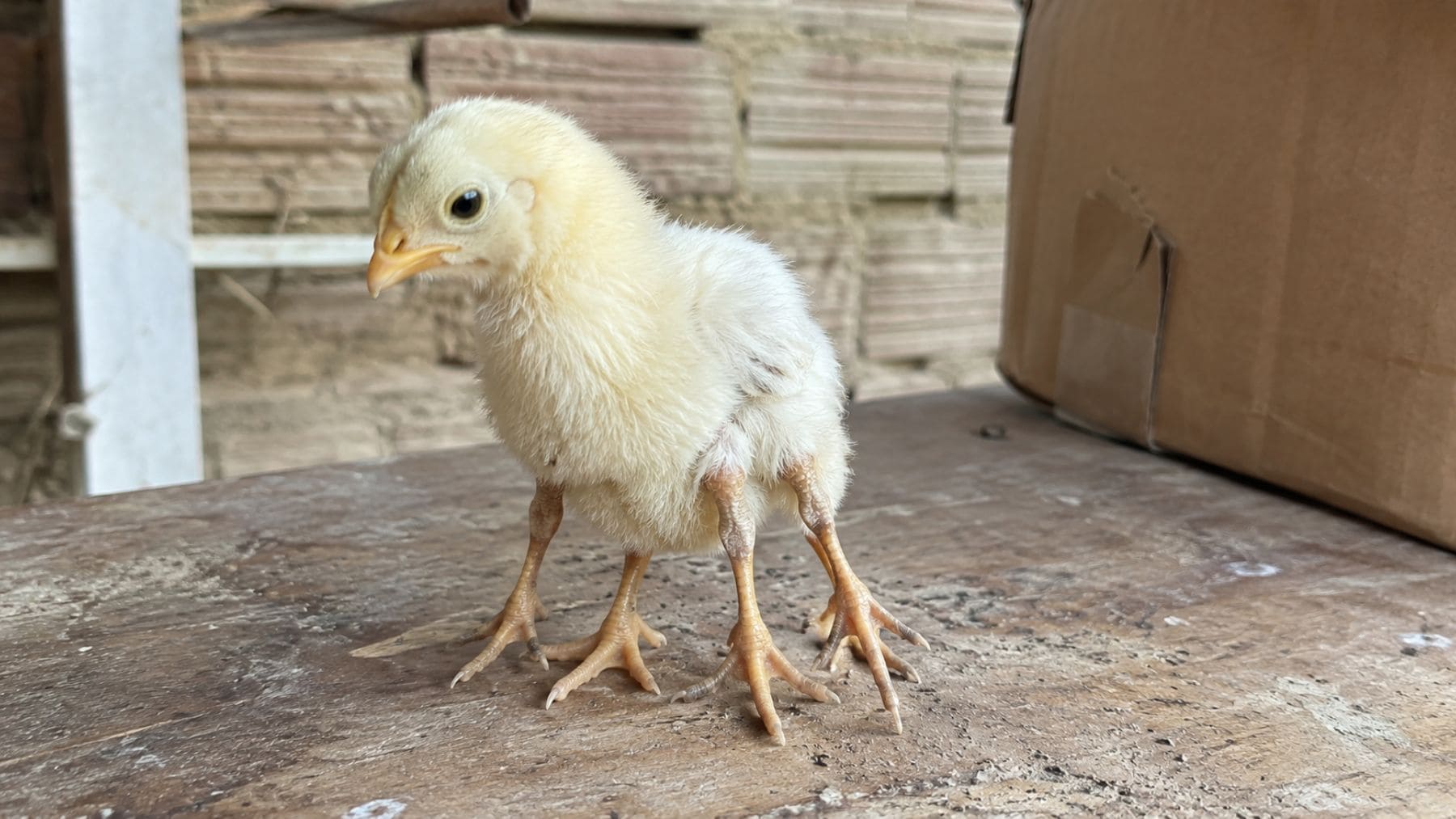
Pollito nace con cuatro patas en São Borja, Brasil, debido a rara mutación genética llamada polimelia
In a surprising event in São Borja, Rio Grande do Sul, a chick has been born with an unusual feature: four legs. This discovery has captured the attention of Brazilian experts, who are investigating this rare mutation that, so far, does not affect the bird’s ability to feed or move.
The strange case of this chick is due to a medical condition known as polymelia, which causes the development of additional limbs from birth. Although it only uses the front legs to walk, the bird’s well-being will depend on whether the extra legs cause discomfort or prevent access to food and water.
The chick was born on June 12 at the farm of producer Jorge Pinheiro. According to Pinheiro, the chick is active and eats well, despite the fact that the two extra legs do not have mobility. This peculiar case has been reviewed by veterinarian Vladimir Pinheiro do Nascimento, who describes it as “quite unusual” and suggests it could be due to a genetic predisposition or spontaneous mutation.
Although polymelia is not considered a contagious disease, it is important to understand that it is a deformation of embryonic development. This means that during the formation of the embryo in the egg, alterations occur that result in malformations.
Experts emphasize that each case of polymelia is unique and a specific cause cannot always be identified. Genetic and environmental factors may be part of the puzzle, but one should not rush to blame the breeder, the feeding, or the incubation process.
The priority is to ensure that the chick can lead a normal life. If it continues eating, drinking, and moving without pain, it could develop properly, although always under observation.
Scientists have documented similar cases in birds, but according to a study in the Journal of Veterinary Diagnostic Investigation, these reports are scarce.
In conclusion, although the images of this chick are striking, it is crucial to focus on its care and well-being, closely observing any changes in its health or mobility that may require veterinary intervention.
In a bold attempt to mitigate the impact of climate change, scientists are exploring methods…
An unprecedented paleontological discovery has taken place in the Antarctica, where a dinosaur fossil remained…
The Forest Conservation Institute (ICF) reported that during the 2026 season, forest fires have ravaged…
Los satélites de la NASA captaron un fenómeno sorprendente en el glaciar Stonebreen, ubicado en…
A new conservation operation allowed a jaguarundi and a capybara to return to their natural…
The presence of a triangle with a number on the base of bottles and plastic…