



In Patagonia, the invasive mink advances unchecked through rivers and lakes and threatens native species, productive activities, and public health in southern Argentina.
This exotic mammal, introduced in the 20th century in both Argentina and Chile, now colonizes from Neuquén to Tierra del Fuego.
However, it is not a national problem: currently, its presence as an introduced species is recorded in 33 countries in Europe, South America, and Asia.
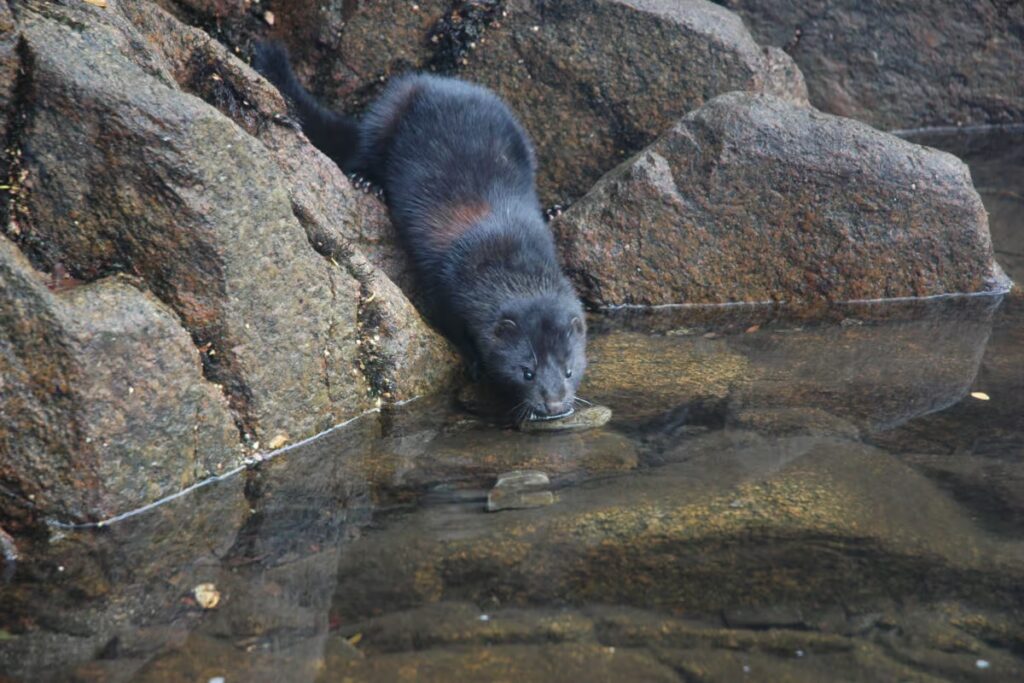
Originally from North America, the American mink is a semi-aquatic carnivorous mammal with crepuscular habits and solitary behavior.
It inhabits rivers, streams, lakes, ponds, wetlands and even the sea, always in areas with woody vegetation cover.
How the invasive American mink arrived in Patagonia
The arrival of the invasive mink in the region was not accidental. During the 1930s, Argentina and Chile promoted public and private initiatives to develop the fur industry.
Among these was the establishment of American mink farms to use their hides and furs in clothing.
The study ‘The American mink in Patagonia: a historical and socio-ecological analysis of research and management‘ conducted jointly by Argentine and Chilean specialists tracks the history of the mink invasion in the area.
This was conducted by Alejandro Valenzuela, from the National Parks Administration, along with Maximiliano Sepúlveda (Pontifical Catholic University of Chile), José Cabello (Patagonia Wildlife Ltda.), and Christopher Anderson (National University of Tierra del Fuego).
According to the analysis, the first record corresponds to a farm in Punta Arenas, Chile, established between 1934 and 1936.
Between the 1930s and 1950s, several farms were established in Chubut, Neuquén, and Tierra del Fuego, some active until the 1970s.
However, after the economic failure of the fur business, the animals were released or escaped. The first release record dates back to 1948, in the Argentine sector of the Isla Grande de Tierra del Fuego.
By the 1960s, there were already established groups in the wild. Since then, the species has not stopped invading new areas and today threatens the biodiversity and human activities.
There have even been movements of invasive mink specimens between Argentina and Chile.

A generalist predator with high invasive capacity
What makes the invasive mink especially dangerous is its broad and flexible diet. As described by specialists, the mink is a “strict but generalist carnivore”.
Its diet includes:
- insects;
- micromammals;
- crustaceans;
- mollusks;
- fish;
- amphibians;
- reptiles;
- birds, and;
- geese.
According to the researchers, “all these characteristics give it a great advantage to adapt and invade a new environment“.
Added to this are its high reproductive rate and delayed implantation, a reproductive characteristic that increases its plasticity and ability to colonize different habitats.
The introduction of this carnivore, the specialists point out, “represents one of the main threats to regional biodiversity, especially in geographically isolated systems, where it can cause extinctions of native species“.

The impact of the invasive mink on fauna, economy, and public health
This invasive mink affects local fauna on multiple levels. Among its main victims are:
- Water birds, such as the hooded grebe, a critically endangered endemic species
- Fish from Patagonian rivers and streams
- Small native mammals like the huillín and the coypu, with whom it also competes for territory
The damage is not limited to the ecological. Its presence causes million-dollar losses in fish farming and affects poultry farming.
Additionally, it harms tourism related to bird watching and recreational fishing, key activities for the regional economy.
The health risk is also concerning. From the province of Neuquén, they indicated that the mink “can act as a reservoir or transmitter of various pathogens”, capable of affecting domestic animals and people.
In Neuquén, the Terrestrial Ecology Group —composed of CEAN and researchers from Inibioma (Conicet-UNCo)— conducts comprehensive studies to map the animal’s distribution and assess its impact.
The province emphasized that population control is a “necessary and unavoidable tool”, and that the work is coordinated among wildlife wardens, Protected Natural Areas, local communities, and scientific institutions.
Recently, the American Mink Control Program began to be deployed in Lago Puelo National Park, an initiative aimed at stopping its expansion before the damage becomes irreversible.



