



For years, the presence of sea turtles in Argentina was considered occasional. However, new research shows that it is part of complex international migratory routes.
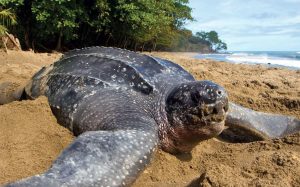
In this context, the leatherback turtle emerges as a key species. Additionally, its arrival in the South Atlantic is linked to essential ecosystems for its feeding.
Studies indicate that specimens from different regions converge in Argentine waters. Therefore, the country gains importance in their conservation.
A biological corridor connecting continents
The turtles arriving in Argentina come from multiple areas. Consequently, individuals have been recorded from northern Brazil and from Africa.
Among the countries of origin are Ghana, Gabon, and the Congo. Likewise, they belong to different units of population management.
Some of these populations are in a critical state. Therefore, their protection requires coordinated strategies on a global scale.
The coast of the Province of Buenos Aires plays a central role. There, the abundance of jellyfish makes the area a key feeding site.

Invisible threats in the ocean
Despite its ecological importance, the species faces multiple risks. Firstly, plastic pollution severely affects its survival.
Moreover, the ingestion of waste can cause intestinal obstructions. Consequently, many specimens die or become weakened.
Similarly, interaction with fishing gear increases the danger. Therefore, incidental capture remains a significant threat.
Thus, environmental deterioration directly impacts the species. This highlights the need for changes in human practices.
Science and community: a key alliance
The knowledge about these turtles is built in a collective manner. Consequently, fishermen, lifeguards, and citizens play a fundamental role.
Additionally, reports allow locating specimens in the sea. Therefore, they facilitate scientific research and enable the placement of satellite transmitters. In this way, their migratory routes are studied.
The work is driven by organizations like Fundación Vida Silvestre Argentina and CONICET. Thus, science and territory are articulated.
The leatherback turtle and its conservation status
The leatherback turtle is classified as vulnerable globally. However, in Argentina, its situation is more delicate.
As a consequence, it is considered endangered within the country. Additionally, some of its populations face critical risk.
It is a fundamental species for the marine balance. Therefore, its disappearance would have chain effects.
Moreover, its life cycle presents challenges for its study. Thus, its conservation requires sustained efforts.
What are the benefits of an articulated conservation initiative
The joint work between organizations and the State generates multiple benefits. Consequently, it improves the protection of marine biodiversity.
Additionally, it strengthens the production of scientific knowledge. Therefore, it positions Argentina in global research. In turn, it promotes environmental education in society. Thus, it encourages more sustainable habits.
It also helps reduce threats like incidental fishing and pollution. Thus, the chances of survival increase.
An environmental challenge that transcends borders
The conservation of the leatherback turtle involves international cooperation. Consequently, its protection depends on multiple countries.
Moreover, it requires sustained public policies. Therefore, the National Action Plan plays a strategic role.
Additionally, citizen participation is indispensable. Thus, every action contributes to its preservation.
Ultimately, the presence of this species in Argentina reveals an interconnected system. Thus, caring for its habitats is protecting the health of the oceans.



