



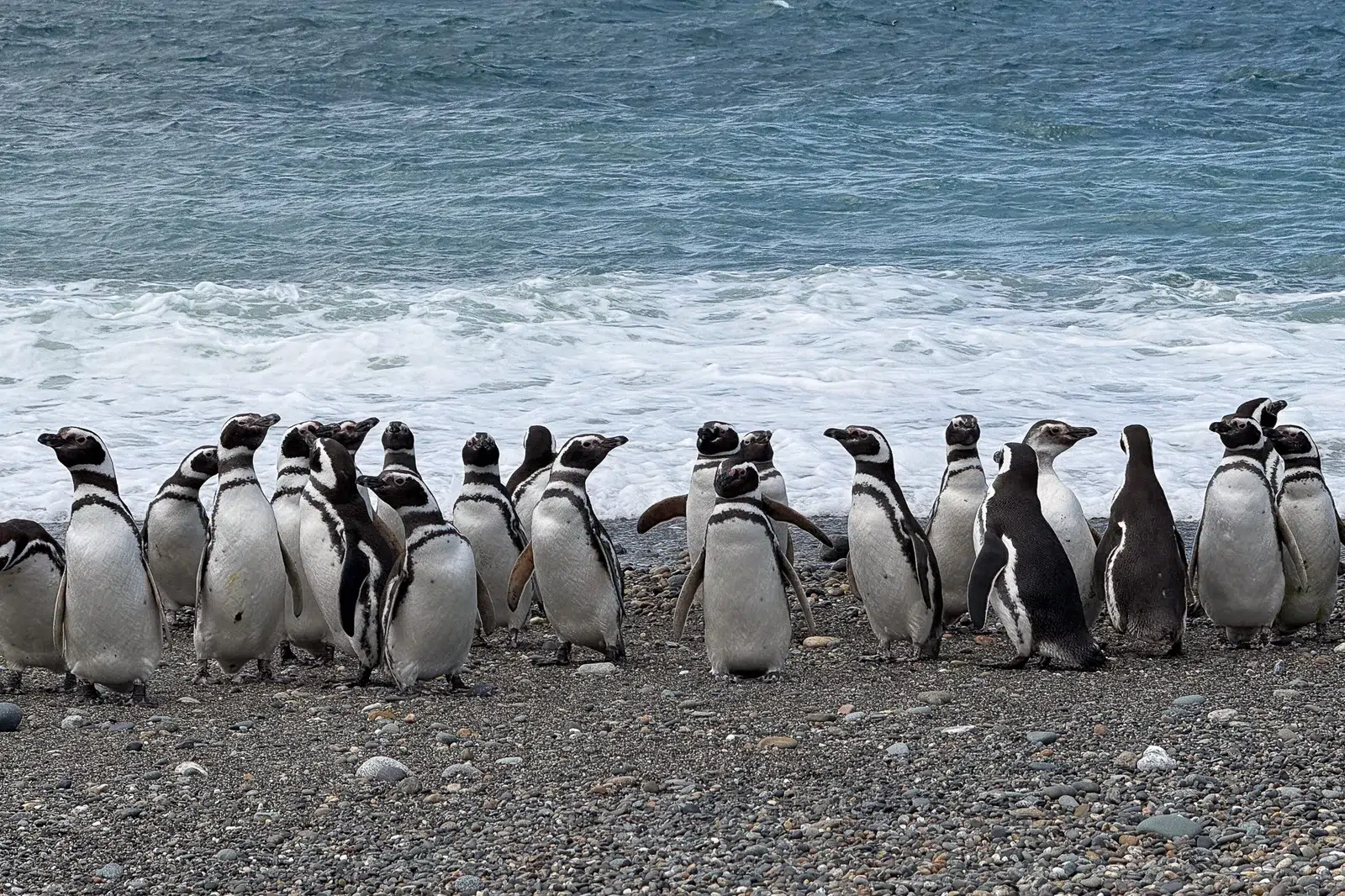
At the southern tip of Santa Cruz, where the wind and the sea set the pace, lies the colony of Magellanic penguins at Cabo Vírgenes, one of the largest and most unique in Argentina. Its almost total vegetation cover sets it apart from other colonies and makes it a key site for the species.
Researcher Esteban Frere, with more than four decades of work in the area, highlights that it is an exceptional place due to its size and persistence in a hostile environment.
Journeys to Feed the Chicks
One of the current research focuses is understanding the movements of adults during breeding. Initial results show that penguins travel greater distances than expected, reaching up to 120 km north of the colony. Additionally, trips that used to last less than 24 hours can now extend up to a day and a half.
The care dynamic is shared:
- At the beginning, one parent stays in the nest while the other searches for food.
- When the chicks are one month old, both parents go out together in search of food.
Myths and Realities About Fidelity
Although the romantic image of penguin fidelity is popular, Frere clarifies that it is a myth. Couples may stay together for a few years, but not for life.
There are even pair crossings in the same season, with females mating with more than one male. Some unions last up to ten years, others just a year and a half.
Partial Migration
At the end of the breeding season, around late March, dispersion begins. In Cabo Vírgenes, a particular phenomenon is observed:
- Some individuals migrate north, traveling up to 4,000 km.
- Others stay nearby, about 300 or 400 km from the colony, as long as food is available.
This behavior, known as partial migration, reflects the diversity of strategies within the same colony.
Technology and Monitoring
Tracking combines simple methods and advanced technology:
- Chips to identify individuals without the need for constant handling.
- GPS during breeding and geolocators during migration. Researchers avoid real-time satellite devices to not affect the animals’ hydrodynamics, prioritizing their well-being.
Threats and Climate Change
Local threats include incidental capture and pollution, although difficult to quantify. However, the main concern is climate change, which alters sea conditions and prey distribution. This makes reproduction and migration more unpredictable, with possible impacts on colony distribution and reproduction rates.
A Life Dedicated to Penguins
For Frere, the landscape between Cabo Vírgenes and Punta Dúngenes, where the Strait of Magellan begins, sums up the essence of these animals: surviving in a changing and hostile environment. “It has been 40 years of a great adventure of knowledge and fascination,” he states, reflecting the passion that guides his work.
The story of Cabo Vírgenes reminds us that there is still much to understand about these extraordinary birds. Each season brings new questions and challenges, in a southern corner where science and conservation meet to protect a species that symbolizes resilience and adaptation.


