



A little over a month after her relocation, the jaguar Pará continues under strict monitoring in her new habitat along with her cubs.
The intervention, carried out in October, represents an unprecedented milestone at a global level in conservation of felines.
The relocation of the jaguar Pará and her two cubs was an exceptional measure adopted in a critical situation that endangered their lives.
In mid-October, Pará, who was injured, was captured along with her cubs.
After several months, an inter-institutional team finally managed to successfully relocate her to the Green Corridor of the Yabotí Biosphere Reserve.
According to specialists, other management alternatives had not been successful. Now, experts are monitoring her adaptation.
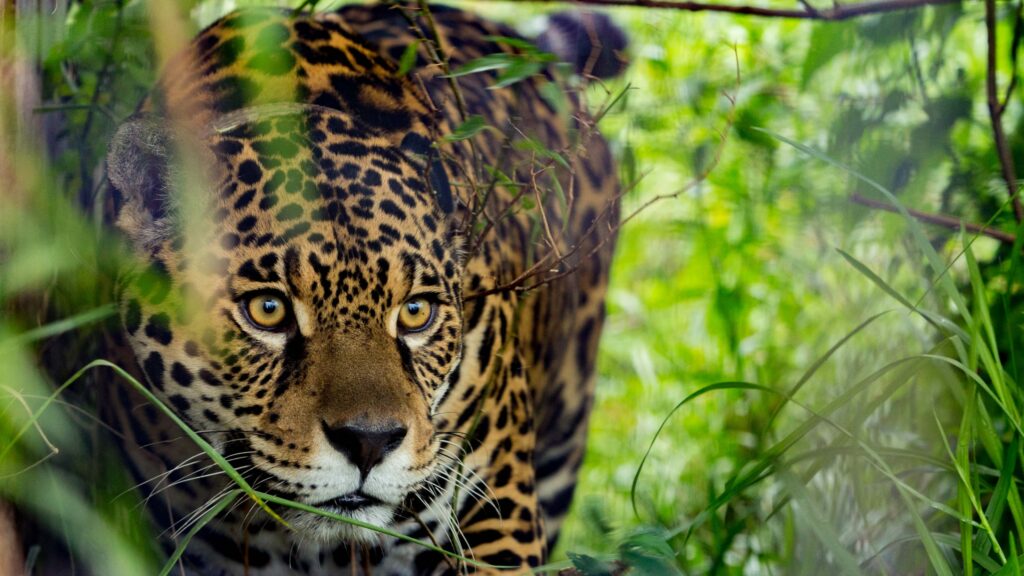
The injury suffered by the jaguar Pará
“Pará” had suffered the loss of an eye in an accident, which drastically reduced her hunting ability in the Misiones jungle.
The female, approximately seven years old, needed to feed her two cubs: a male and a female.
This physical limitation forced her to adopt an unusual behavior for her species, occasionally attacking livestock in inhabited areas.
Therefore, since February of this year, residents of the area known as “2000 Hectares“, a settlement adjacent to Iguazú National Park, began reporting frequent sightings of “Pará”.
The camera traps later repeatedly recorded her presence while she roamed in search of food near homes.
Thus, the controlled capture became a priority to protect both the animal and the local community and their domestic animals.
After the capture operation, the controlled relocation of the family group to a safer area was established as the only viable option to ensure their survival.
According to experts, the Green Corridor of the Yabotí Biosphere Reserve offers more favorable conditions for Pará and will allow the repopulation of the area.
Unprecedented operation to relocate the jaguar Pará and her cubs
The relocation procedure constituted an unprecedented intervention at a global level, as the wild female and her two cubs were moved from a high-risk environment to another natural setting.
Each stage was designed under specialized technical criteria, adjusting the process to the biological behavior of the species. The goal: to maximize the possibilities of adaptation in freedom.
The decision was agreed upon by various institutions that make up the Paranaense Jungle Subcommittee for the Conservation of the Jaguar:
- Ministry of Ecology and Renewable Natural Resources of Misiones
- Misiones Biodiversity Institute (IMiBio)
- Jaguar Project (CeIBA-CONICET)
- Azara Foundation (Centro Güirá Oga)
- National Parks Administration
- Argentine Birds Association
All agreed that the intervention was imperative given the severity of the situation.

Satellite tracking and natural movements
More than a month after the controlled release of Pará and her cubs, in which human presence was minimized, monitoring continues.
The tracking is carried out using a satellite collar placed on the adult specimen, which emits periodic signals and allows tracking of her movements.
This device can only be placed on adult animals. For this reason, it is not possible to determine with certainty the current situation of the cubs.
By the end of October, variable movements of the jaguar Pará were recorded inside and outside the immediate area of influence.
The readings from the device indicated continuity in her movements within environments compatible with her natural behavior.
Additionally, no situations representing an additional risk or alterations in her expected adaptation pattern were recorded.
Confidentiality to protect jaguars from hunters
The area remains under permanent monitoring through patrols, camera traps, and technical tours.
This allows for constant monitoring without interfering in the natural development of the species.
The data related to the release site and the records obtained are strictly confidential.
“The disclosure of sensitive information can compromise the results of the relocation process and endanger the survival of the specimens,” authorities point out.
The recent experience with the jaguar Acaí in El Impenetrable National Park, from whom no records have yet been obtained, reflects the vulnerability of these processes.
The Government of Misiones is working steadily on the protection of the jaguar, an emblematic species of the Misiones jungle and key to the ecosystem’s balance.
The current period is crucial for the jaguar Pará to fully adapt to her new environment.



