



Researchers discovered a new species of dumbo octopus in the submarine canyon of Ningaloo, Australia. This finding highlights the unique biodiversity of Australian deep-sea environments.
The new species belongs to the genus Grimpoteuthis, known for its fins resembling the ears of Disney’s character, Dumbo.
What the new dumbo octopus species is like
These octopuses inhabit depths of up to 4000 meters and are characterized by their gelatinous body and their ability to move slowly along the seabed.
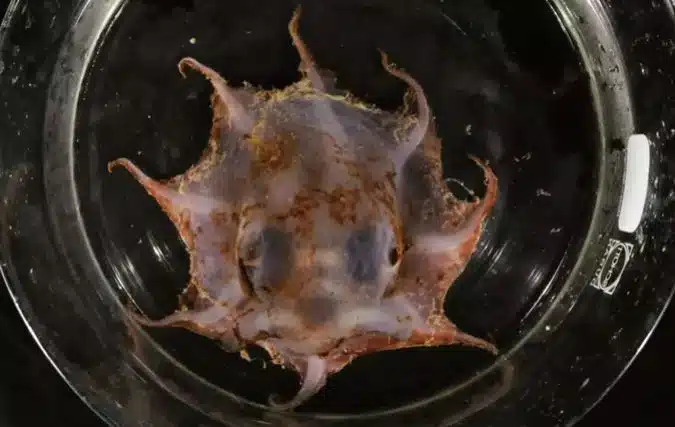 This is the new octopus. (Photo: CSIRO).[/caption>
They reach about 4 centimeters in diameter, but little is known about their ecology and lifestyle, as reported by the Commonwealth Scientific and Industrial Research Organization (CSIRO).
“The discovery of new species of macroscopic marine animals illustrates how little we still know about the deep sea in this area,” stated Dr. Lisa Kirkendale, Head of the Aquatic Zoology Department at the Western Australian Museum.
The flapjack octopus is a creature that changes shape in the depths of the sea, with the ability to flatten its body to resemble a pancake (or flapjack, hence its name) or to rise up to look like a small jelly umbrella.
These octopuses have large eyes in proportion to their body size, enhancing their ability to detect prey in the dimly lit depths where they live.
They feed on worms and small crustaceans, using their tentacles to capture and consume their prey.
Why this discovery is crucial
“These discoveries are vital to help us understand the conservation needs of marine parks and will assist Parks Australia in maintaining its natural values in the future,” added Venetia Joscelyne, Head of the CSIRO National Marine Facility team.
Australian authorities are evaluating measures to conserve deep-sea marine areas and mitigate environmental impacts. However, the effective implementation of conservation policies faces challenges related to regulation and surveillance in hard-to-access areas.



