



The situation of the **orangutans, in [critical danger of extinction](https://noticiasambientales.com/animales/elefantes-en-peligro-de-12-millones-a-400-000-ejemplares-en-un-siglo-una-caida-poblacional-que-exige-accion-urgente/)**, is going through a delicate moment in **Borneo**, the island where **90%** of the world’s population of the species lives.
However, due to various reasons mainly related to the loss or reduction of their natural habitat, the numbers marking the decline in specimens in recent decades are extreme.
In this context, the [**Borneo Orangutan Survival Foundation (BOSF)**](https://www.orangutan.or.id/), considered the largest in its field, works on the island. It leads conservation efforts by rescuing and rehabilitating these primates at a center in **Kalimantan**, the Indonesian part of the island.
## Deforestation, the main threat to the island and orangutans
The foundation’s work takes place in a context of [intense deforestation](https://noticiasambientales.com/medio-ambiente/la-sequia-que-vive-brasil-en-mas-de-la-mitad-de-su-territorio-es-a-causa-de-la-deforestacion/). Formerly covered by **75% of jungle**, Borneo lost half of its tropical forest. This massive habitat reduction is the main cause of the **decline in the orangutan population**.
Between **1999 and 2015**, the orangutan population in Borneo was halved, and today it is estimated that only **100,000 specimens** remain.
The expansion of **palm oil plantations** and **mining** projects project the disappearance of more than a quarter of the current population by 2032.
## From “jungle school” to freedom: how BOSF works
BOSF’s mission goes beyond rescue. Young orangutans attend a “**jungle school**” to learn essential skills such as climbing trees and finding food. The goal is to prepare them for [reintroduction into protected areas](https://noticiasambientales.com/animales/aguila-poma-el-imponente-depredador-de-las-yungas-que-busca-alejarse-de-la-extincion-en-las-selvas-de-jujuy/).
The most advanced ones live on artificial islands, while others, under observation, **remain in elevated cages**.
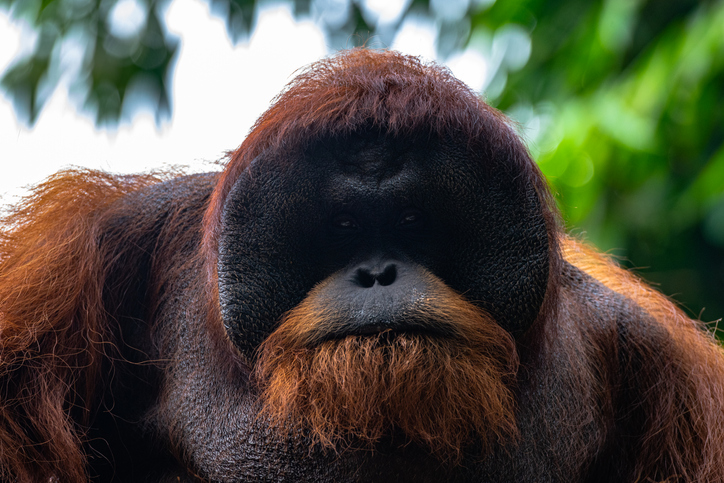
Since its foundation in 1991, BOSF has **successfully released 533 orangutans**. However, 359 permanent residents cannot return to nature due to diseases or traumas, like **Kopral**, a male who lost his arms due to an electric shock.
In addition to animal rehabilitation, BOSF also works on **habitat restoration**. In the **early 2000s**, the foundation reforested nearly 5,000 acres, planting 740 native species. Collaboration with local communities has been crucial, allowing them to grow fruits in exchange for protecting the trees.
## Challenges for orangutan conservation: what are these animals like
The **conservation of orangutans is expensive** and requires years of dedication. Maintaining a single specimen can cost up to **$500 monthly, according to experts**.
Furthermore, the species’ biology presents some particular challenges due to its unique characteristics. Females have long intervals between births, and their **adaptation to changes is slow**. Genomic research conducted in 2011 showed that the species has changed very little in the last **15 million years**, reflecting a slow adaptation to human changes.
Despite these difficulties, orangutans surprise scientists with their intelligence, using medicinal plants and making tools, highlighting the importance of protecting this unique species.
## Infrastructure projects and their consequences

The future of the species is further complicated by large-scale infrastructure projects, such as the relocation of Indonesia’s capital to a new city, Nusantara, near a BOSF center.
Despite promises of a **”green forest city”**, experts warn that development of this magnitude will negatively impact threatened species.



