



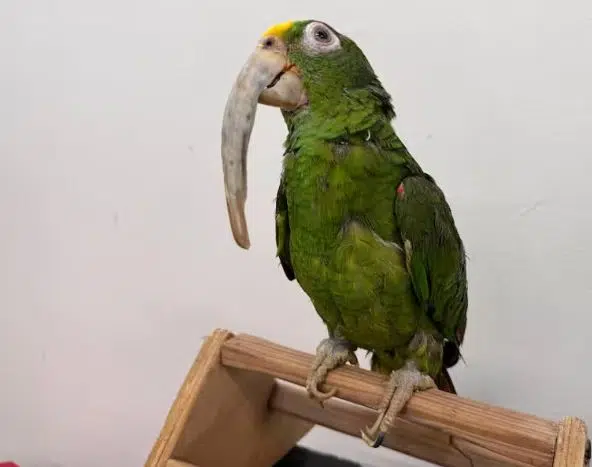
A new alarm for wildlife trafficking has been raised in Colombia in recent days. A yellow-fronted Amazon parrot (Amazona ochrocephala), a protected species, was rescued after 32 years in captivity.
The rescue was led by the Center for Attention, Assessment, and Rehabilitation (CAVR) of the Metropolitan Area of the Aburrá Valley.
The case highlights the devastating consequences of this crime and the irresponsible ownership of exotic animals as pets.
Wildlife Trafficking in Colombia: the case of the yellow-fronted Amazon parrot
The bird arrived at the rehabilitation center with abnormal and deformed beak growth, a result of the lack of natural surfaces for wear. Additionally, it had severe overgrowth in its nails, which hindered support and caused chronic and painful inflammation in its feet.
The veterinary team at CAVR also identified abscesses in the feet, greasy plumage, areas with feather loss, and scales on the skin, all signs of a deep compromise to its physical and emotional well-being.
Since 2024, CAVR has received 748 parrots of different species, of which 57% entered due to cases related to wildlife trafficking, either through confiscations or voluntary surrenders.
The most common species has been precisely the yellow-fronted Amazon parrot, with 385 individuals, followed by the yellow-bearded Amazon parrot (243) and the blue-headed Amazon parrot (59).
Alejandro Vásquez Campuzano, environmental subdirector of the Metropolitan Area of the Aburrá Valley, made a call to citizens following the case.
“Since 2024, we have received more than 748 parrots, 57% of which have been associated with wildlife trafficking cases. We remind the community not to fall into the trap of trafficking; we must all be protectors of our natural resources,” he said.
The Metropolitan Area reiterates that parrots are not pets. These birds need to fly, feed on fruits and seeds from their habitat, interact with others of their species, and fulfill fundamental ecological functions.
Depriving them of these natural behaviors causes irreversible physical and behavioral damage, even when done with good intentions.



