



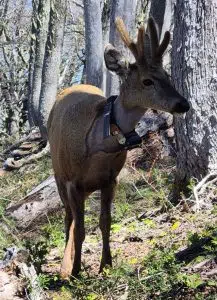
The tracking of a huemul in southern South America opened a new chapter in the understanding of Andean biodiversity. Indeed, the specimen named Newenche traveled more than 116 kilometers, far exceeding previous records and demonstrating the species’ ability to move in search of suitable habitats.
Moreover, this finding was made possible thanks to telemetry radio collars, which allowed monitoring of its movements between the Los Ríos Region in Chile and the provinces of Neuquén and Río Negro. Thus, the evidence confirms that natural ecosystems function as integrated units, beyond political borders.
On the other hand, the study was driven by the Huilo Huilo Foundation along with the National Parks Administration of Argentina, consolidating a binational approach. Thus, scientific cooperation emerges as a key tool for the protection of endangered species.
Ecological restoration: two decades to recover an emblematic species
The case of Newenche is not isolated, but the result of more than 20 years of sustained work. In this sense, the huemul had disappeared from the Los Ríos Region, which motivated the creation of a breeding center in 2005.
Subsequently, the first releases into the wild began in 2016, followed by new reintroductions in 2019. As a result, in 2020, births in the wild were recorded, an event that had not occurred for decades in that region.
Likewise, these advances reflect an integral conservation strategy that combines science, land management, and constant monitoring. Therefore, the recovery of the huemul shows that well-planned human intervention can reverse local extinction processes.
Biological corridors and land management
The journey of Newenche also highlights the importance of transboundary biological corridors. Indeed, its movement to areas such as the Lanín National Park and the Nahuel Huapi National Park demonstrates that these connected spaces allow for the natural expansion of species.
However, this achievement required concrete actions on the territory. Among them, the reduction of feral cattle, dog control, and tourism regulation were fundamental to minimizing threats.
At the same time, these measures show that modern conservation is not limited to isolated protected areas. On the contrary, it involves managing entire landscapes where human activities and biodiversity coexist.
Conservation status of the Andean huemul
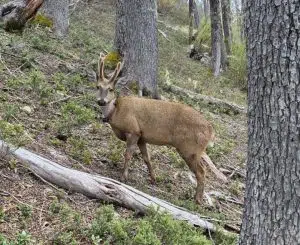
The huemul is one of the most threatened species in Patagonia. Currently, its populations are small and fragmented, limiting its capacity for natural recovery.
Among the main threats are habitat loss, competition with livestock, poaching, and the presence of domestic animals. Additionally, climate change exacerbates these pressures by altering the conditions of mountain ecosystems.
Nevertheless, initiatives such as reintroduction and the strengthening of biological corridors offer encouraging prospects. Consequently, the case of Newenche demonstrates that, with sustained policies, it is possible to improve the conservation status of the species.
A future tied to active conservation
The journey of this huemul confirms that ecosystems still retain their functionality, as long as adequate conditions are maintained. In this context, active conservation emerges as a key approach to ensuring the survival of emblematic species.
Moreover, integrating local communities is essential to sustain these processes in the long term. Responsible tourism and environmental education, for example, allow for generating economic benefits without compromising the natural environment.
Finally, Newenche’s journey not only represents a record but also a sign of ecological resilience. Thus, Patagonia reaffirms its potential as a biodiversity refuge, as long as the commitment to its protection is maintained.



