



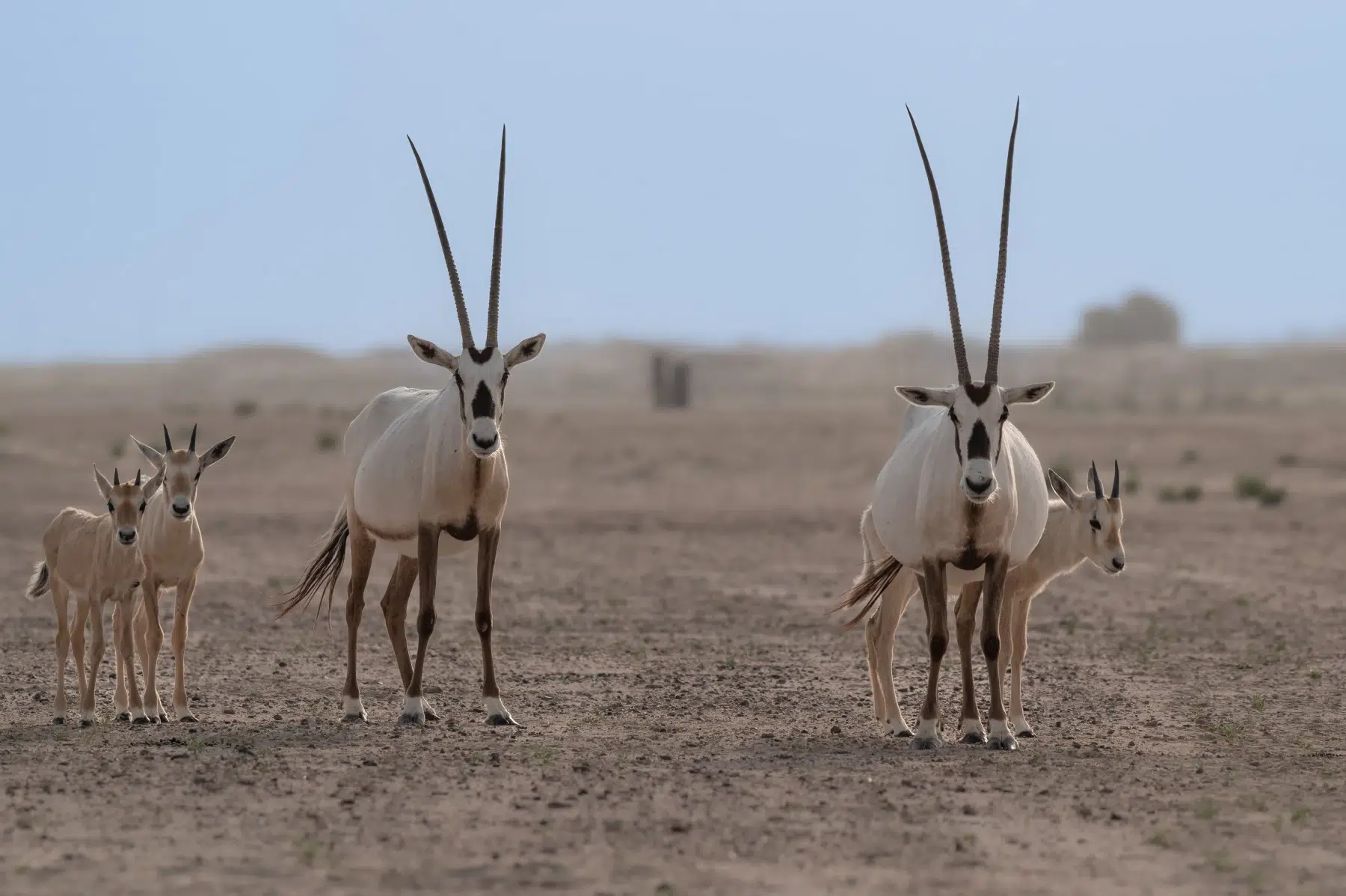
In one of the most arid regions on the planet, the Sahara, a conservation project defied all predictions. In 2016, the government of Chad, along with the Sahara Conservation Fund and the Environment Agency of Abu Dhabi, launched a plan to reintroduce the scimitar-horned oryx (Oryx dammah), an antelope extinct in the wild since the year 2000. The chosen reserve covers 78,000 km², an area larger than Ireland.
The oryx: natural engineer of the desert
The Saharan oryx was perfectly adapted to extreme heat:
- It could withstand more than 46 °C without sweating.
- It raised its body temperature to conserve water.
- It dug into the sand with its hooves in search of roots and moisture.
Each of these actions had an invisible but crucial ecological effect: retaining water, stirring fertile soil, and creating microdepressions where seeds could germinate. Its disappearance had left the desert without one of its natural architects.
The first years of the project
More than 70 international experts participated in the operation. The animals were transported from the United Arab Emirates, equipped with GPS collars, and underwent a readaptation period.
The first months were brutal: temperatures exceeding 50 °C, offspring that did not survive, and electronic devices melting under the sun. However, the project continued.
Unexpected changes in the ecosystem
Over time, the oryx began to transform the landscape:
- Their digging allowed rainwater to penetrate the soil.
- Their resting areas became moist microdepressions.
- Seeds carried in their fur germinated.
- Their dung enriched the soil and their hooves compacted the sand to retain moisture.
Soon grasses, insects, and small reptiles appeared. Satellite images confirmed the impact: a measurable increase in vegetation cover in areas where the oryx roamed freely.
Scientific and genetic advances
Researchers from the Smithsonian developed assisted reproduction techniques without anesthesia, crucial for animals weighing more than 200 kilos. Thanks to this, nearly 90% of the original genetic diversity of the species was restored.
In 2023, the International Union for Conservation of Nature (IUCN) changed the oryx’s status from “extinct in the wild” to “endangered.”
Expansion of the model
Today, neighboring countries like Niger and Tunisia are replicating the experience, compared by scientists to the reintroduction of wolves in Yellowstone. The lesson is clear: sometimes the solution is not in building more infrastructure, but in returning the species we took from the ecosystem.
The return of the Saharan oryx demonstrates that nature can be its own ally in the fight against desertification. In a place where everything seemed dead, it took just one antelope for the desert to start breathing again.


