



Dolphins are one of the most popular animals worldwide due to their friendliness and intelligence. However, there is a species of dolphins that stands out for its size: the Hector’s dolphin.
This dolphin species, known as the smallest in the world, is also known for its great agility that allows them to perform a wide range of acrobatics underwater. In fact, it was this same quality that surprised the authors of the study published in Conservation Letters.
According to the article, these animals can barrel roll, even at 120 meters deep, and feed upside down near the seafloor. While these behaviors were unknown until then, what surprised scientists was their ability to reach these depths.
This was because it was unlikely for an animal of this species, less than 1.5 meters long, to descend so many meters.
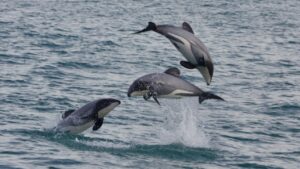 Hector’s dolphin, the smallest dolphin in the world.
Tracking with Surprising Results
These behaviors were discovered through underwater tracking devices operated by experts from the University of Auckland, New Zealand. The team placed sound and motion recording devices, called DTAG, on 11 specimens in the Clifford Marine Mammal Sanctuary and Cloudy Bay.
This allowed them to record how dolphins changed tactics depending on where they were feeding. When they were near the seabed, they moved slowly to catch flatfish and cod. In intermediate waters, their behavior changed as they increased energy, performing somersaults to catch small fish in schools.
To visualize the results, scientists created animations of a dolphin’s dives. They also added the sounds of the dolphin’s echolocation clicks, which transform into a buzzing sound similar to an electric tool when locating prey.
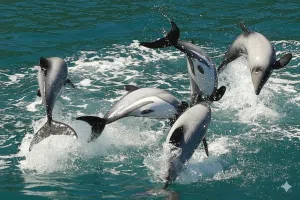 New Zealand scientists discover new abilities of the world’s smallest dolphin, Hector’s dolphin. Photo: Hector’s dolphin.
The World’s Smallest Dolphin, Owner of Unique Characteristics
The Hector’s dolphin is one of the smallest dolphin species in the world and exclusively inhabits waters of New Zealand. Its compact body, short snout, and rounded dorsal fin shaped like “Mickey Mouse ears” make it unmistakable. Being an endemic species, its conservation depends entirely on measures taken in that region.
There are two recognized subspecies: the Hector’s dolphin proper, which lives in the South Island, and the Maui dolphin, which inhabits the North Island and is critically endangered. The latter is one of the most threatened populations of cetaceans on the planet, with fewer than a hundred estimated individuals.
The main threats they face are gillnets and bycatch, along with coastal pollution and ocean noise. These factors, combined with their restricted distribution, make them extremely vulnerable. The creation of marine protected areas and fishing regulations are key to ensuring their survival.


