



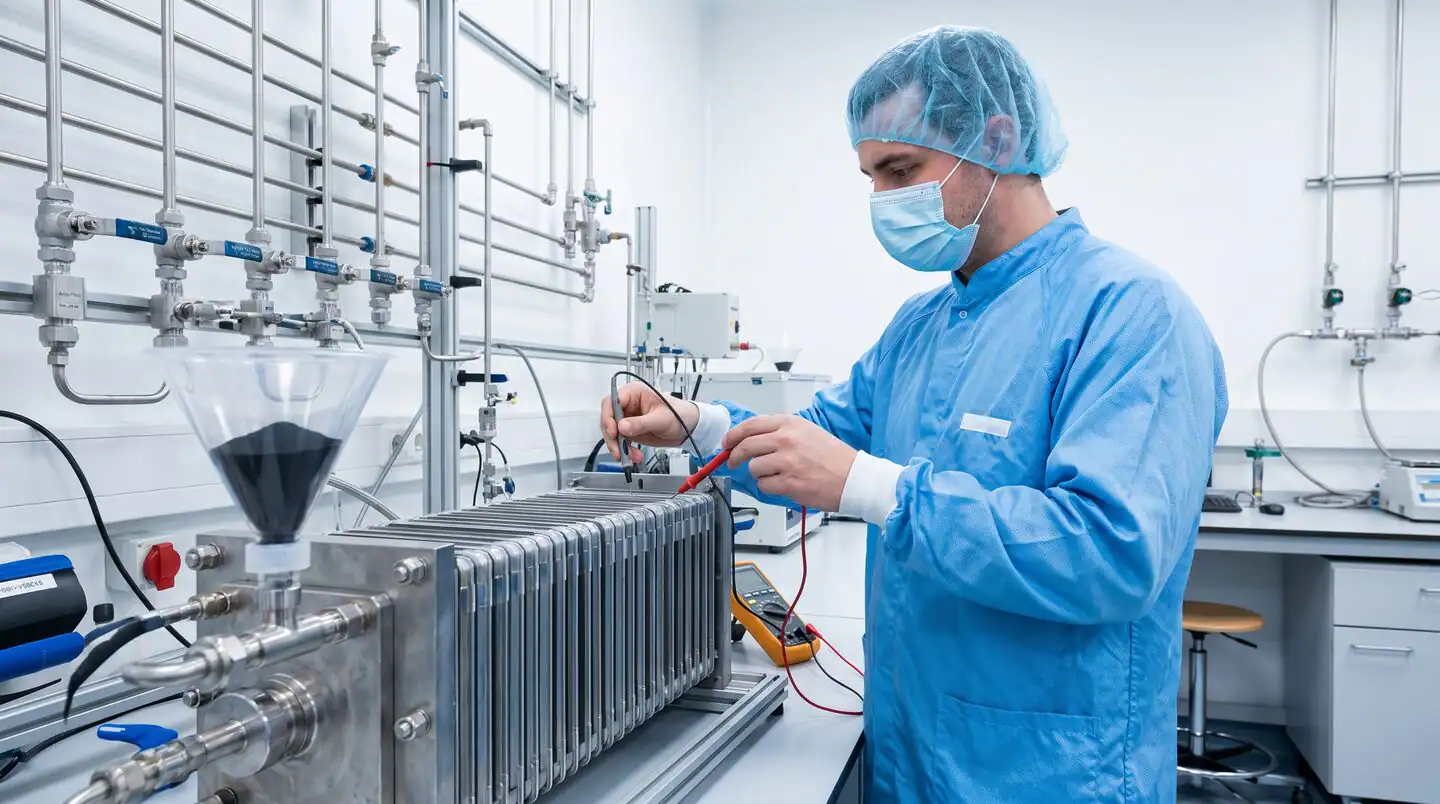
Chinese researchers have presented the ZC-DCFC (Zero-Carbon Direct Coal Fuel Cell), an electrochemical battery that directly converts carbon into electricity without open combustion. Instead of burning coal to generate steam and move turbines, the system uses it as fuel in a sealed circuit:
- At the anode, carbon releases electrons.
- These electrons travel through an external circuit and generate current.
- At the cathode, oxygen collects the electrons and completes the reaction.
The result is a more efficient process, with much lower thermal losses than in a conventional power plant.
Main Advantages
- Energy efficiency: up to 80% in the laboratory; in real conditions, between 55–60%.
- Concentrated emissions: CO₂ is generated in a pure stream, which facilitates its capture and storage.
- Reduction of pollutants: avoids the typical gas mixture of combustion (nitrogen, particles, ashes).
Energy Context in China
According to the International Energy Agency, in 2024, 60% of China’s electricity came from coal. In 2025, 78 GW of new thermal power were added, equivalent to dozens of plants.
In this scenario, the ZC-DCFC does not aim to eliminate coal immediately but to make it less harmful while advancing towards renewable energies.
CO₂ Capture and Use
The concentration of emissions opens the door to:
- Geological storage.
- Mineralization to convert it into solid rock.
- Industrial reuse in chemical processes or construction materials.
Examples like Climeworks in Iceland are already exploring these avenues, and China is investigating similar solutions near mining areas.
Technical Challenges
- Coal preparation: grinding to less than 10 microns, removal of sulfur and impurities.
- High temperatures: between 600 °C and 900 °C, which generate corrosion and thermal fatigue problems.
- Impurities: sulfur, chlorine, and alkali metals attack the electrodes.
- Continuous operation: any interruption in the flow can block the cell.
Innovative Ideas
One proposal is to install these cells directly in underground mines (1,000–2,000 meters deep). There, coal would be transformed into electricity without transport to the surface, while CO₂ would be stored underground. Although efficient in theory, it poses safety and maintenance challenges.
The “coal battery” is not a definitive solution but a bridge technology: it reduces the impact of coal while moving towards its replacement. Its greatest value lies in the concept: generating energy by controlling emissions from the source. If it can scale, it could integrate with carbon capture and use systems (CCUS) and become a significant step in the global energy transition.



