



The perovskite solar cells have been raising expectations for years due to their lightweight and high efficiency. However, their fragility against heat and humidity limited their real deployment.
Moreover, the early degradation increased costs and hindered investments, especially in warm regions. Therefore, improving their stability became as urgent as increasing their performance. In this scenario, an advancement from the Xi’an Jiaotong University proposes reinforcing the material from its origin.
Heat, the silent enemy of performance
During manufacturing, perovskite requires heat to order its crystalline structure. However, this same process facilitates the loss of iodide on the surface.
As a consequence, microscopic voids appear that weaken the cell and accelerate its degradation. Over time, these defects reduce power and lifespan.
Until now, many solutions tried to repair the damage afterwards, adding layers and additional industrial steps.
A molecular sealing that acts from the start
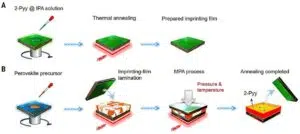
The new strategy changes this logic. Instead of correcting subsequent failures, it creates an active protection during the crystallization of the material.
The method employs a molecule called 2-Pyy, rich in nitrogen and with chemical affinity for the lead in the perovskite. This attaches to the surface and stabilizes its structure.
Thus, the molecular sealing prevents the loss of iodide and reinforces the internal bonds, even under high temperatures.
Results that confirm real stability
Tests were conducted under extreme conditions of 85 °C and 60% humidity, simulating warm climates and coastal areas. After 2,000 hours, the cells retained 98.6% of their power.
At the same time, they achieved an efficiency of 26.6%, one of the highest values recorded in perovskites. This combination of performance and durability marks a turning point. Additionally, the process uses reusable glass plates, which reduces waste and industrial costs.
Scaling and energy transition
The advancement fits with the development of tandem modules, where perovskite is integrated over conventional silicon. This combination allows better utilization of the solar spectrum.
Europe and Asia are already testing these technologies in pilot lines, and a more robust sealing facilitates their transition to mass production. The challenge now is to replicate the method in large panels.
If this stage is overcome, perovskite could cease to be a promise and become a daily solution.

What are its benefits?
The increase in durability reduces the need for frequent replacements and, with it, the consumption of materials and energy. This decreases the environmental footprint of solar technology.
Likewise, its low manufacturing cost opens opportunities for projects in regions with limited resources. Schools, health centers, and isolated communities could access clean energy more easily.
Finally, more efficient and resistant panels allow generating more electricity in less space, promoting more sustainable cities and accelerating the transition towards a renewable energy system.



