



A new German development surprises with its innovation in hydroelectric energy: it is the cableKites technology, which harnesses the power of the sea.
This is a power generation system based on underwater “kites” that converts water currents into clean energy without the need for dams.
The model mimics the operation of a ski lift, although in reverse.
The prototype was designed by researchers from the Hochschule München together with the Technical University of Munich and the company Enrope GmbH.
An underwater ski lift that generates renewable energy
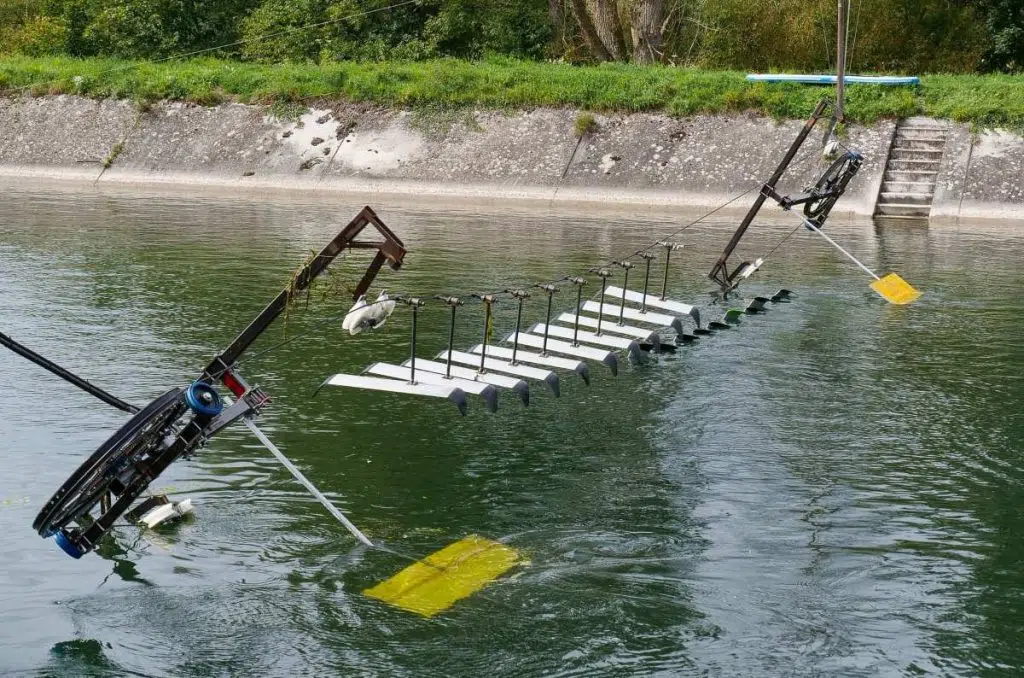
The cableKites technology works inversely to a conventional ski lift.
That is, instead of driving the cable, the marine current moves small hydrodynamic profiles attached to an endless cable.
These “kites” drag the cable, turn the pulleys, and thus activate electric generators that transform the kinetic energy of the water into electricity.
The concept originated from brothers Anton and Peter Glasl, owners of Enrope GmbH, a company specialized in lift construction.
They applied their experience in mountain infrastructure to develop an alternative energy solution.
The first test was conducted in the Mittlere-Isar canal, near Landshut, far from the sea.
There, the 100-kilogram and 18-meter prototype was installed near the Hofham reservoir.
Professor Robert Meier-Staude, a specialist in fluid dynamics, explains that the canal offers “a stable current of 0.6 meters per second, conditions comparable to many European coastal areas.”
Innovations in hydroelectric energy: how the new German system works
The kites of the prototype measure just 1 meter long and 20 centimeters wide.
During the tests, speeds of up to 1.5 meters per second were reached, confirming its stable and efficient behavior underwater.
In this regard, Meier-Staude highlighted a crucial advantage: since water is a thousand times denser than air, an aquatic kite can generate the same energy as an aerial wing being 1,000 times smaller.
This significantly reduces the environmental impact and production costs.
Thus, the system presents multiple benefits for renewable energy generation:
- It does not require dams or aggressive interventions in aquatic ecosystems
- Operates in medium current areas where other technologies are not profitable
- Allows for modular production, scalable and adaptable to different territories
- Contributes to distributed generation, reducing dependence on fossil plants
- Has relatively simple maintenance due to surface access to components
- Enables the reuse of existing infrastructures such as canals or hydraulic passages

German innovation aligns with European green goals
The cableKites project is part of the European Green Deal.
This establishes that, by 2050, the European Union must generate at least 40 gigawatt-hours annually of energy from the oceans.
In a complete operating system, the components would be approximately five times larger than the prototype.
Thus, they could adapt to marine environments with more intense and constant currents.
This technology could be implemented in canals, estuaries, or coastal areas where the installation of traditional turbines is unfeasible.
Its floating or semi-submerged design allows for integration into existing infrastructures without major works.
The team worked for two years preparing this test phase, refining simulations and designs.
The results confirm that, with technical creativity and cross-sector cooperation, it is possible to harness alternative energy sources to move towards a cleaner and more decentralized energy matrix.



