



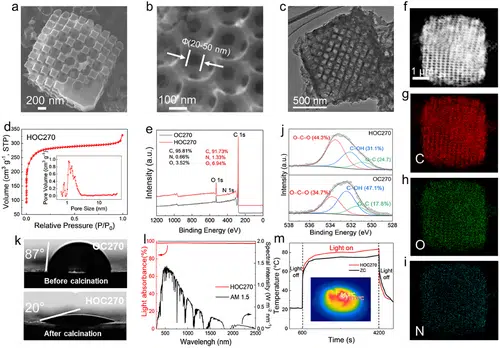
A scientific team from the Hefei Institutes of Physical Science has developed a device capable of producing green hydrogen directly from the moisture in the air. This breakthrough eliminates the need for liquid water or electrical infrastructure, as it operates solely on solar energy. The innovation represents a significant step towards more sustainable and accessible energy systems.
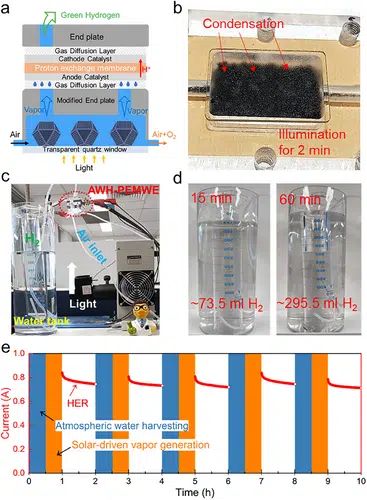
The device combines ambient humidity collection and electrolysis through proton exchange membranes, allowing the separation of hydrogen and oxygen without generating emissions or waste. Its efficiency has been proven even in environments with as little as 20% humidity, opening up possibilities for arid and hard-to-reach regions.
During tests, the system demonstrated remarkable stability, achieving nearly 300 milliliters of hydrogen per hour under 40% humidity conditions. Furthermore, it operated continuously outdoors, confirming its potential as an energy tool in isolated areas.
The relevance of the project lies in overcoming one of the main limitations of green hydrogen: the dependence on large volumes of ultrapure water. Now, with this technology, even deserts could become centers for clean energy production.
Uses and Benefits of Green Hydrogen
Green hydrogen is considered one of the pillars of global energy transition. Its main advantage is that, unlike gray hydrogen, it does not generate carbon emissions during its production or use. Additionally, it can be stored and transported, making it a strategic ally in reducing dependence on fossil fuels.
Among its most promising applications is its use as fuel for heavy and maritime transport, sectors where electrification is complex. It can also power high energy-consuming industries such as steelmaking or cement production, which rely almost exclusively on fossil sources.
In urban areas, green hydrogen could be integrated into energy microgrids and heating systems, promoting decentralization and resilience against power outages. By being produced locally, it reduces the need for large centralized infrastructures, thus lowering costs and vulnerabilities.
An Alternative for the Future of Clean Energy
Beyond its immediate uses, green hydrogen offers far-reaching ecological benefits. Its production from renewable sources helps mitigate climate change by reducing greenhouse gas emissions. Furthermore, its versatility makes it a tool to promote the circular economy and foster energy self-sufficient communities.
The innovation presented in China joins other international projects, such as Desert Bloom Hydrogen in Australia, that aim to harness ambient humidity to obtain hydrogen. These initiatives show that science and technology are paving the way to ensure clean energy in every corner of the planet.
In perspective, if this technology can be scaled with competitive costs, it could democratize access to green hydrogen, allowing both industrialized countries and isolated communities to benefit from a sustainable energy source. This is an advancement that not only drives the energy transition but also strengthens climate justice and equitable access to energy.



