



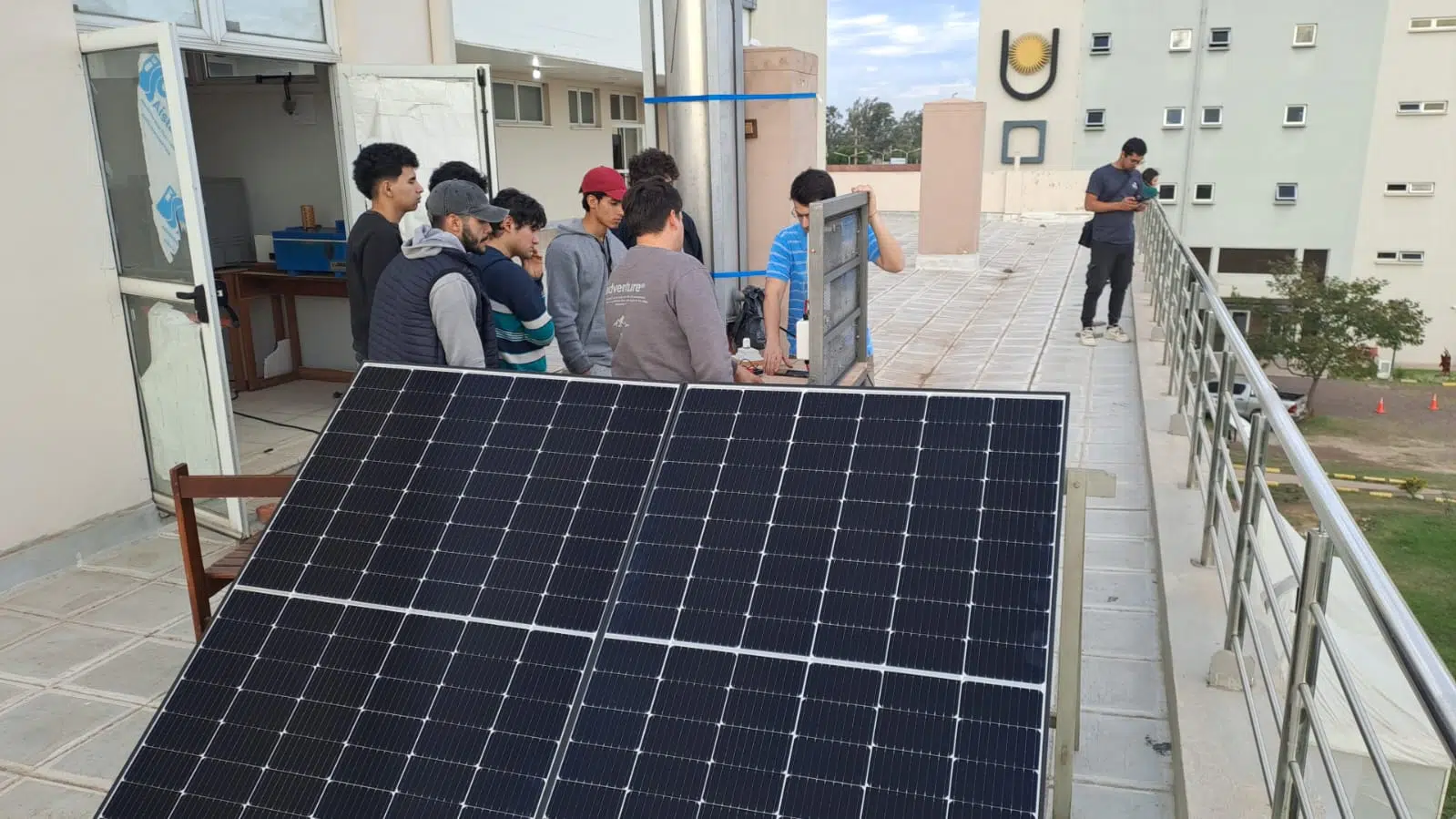
The Civil Engineering intern Tadeo Fernández from the Universidad Nacional del Nordeste (UNNE) is analyzing the technical and economic feasibility of incorporating solar panels in tower buildings in the city of Resistencia, Chaco. His project aims to determine whether integrating photovoltaic systems from the design stage can reduce electricity consumption and move towards more efficient constructions.
The work, titled “Strategies for Photovoltaic Integration in High-Rise Building Projects in Resistencia”, is developed within the framework of a Scientific Vocations Stimulus Scholarship (EVC-CIN), under the guidance of researchers Luis Vera and Claudia Pilar.
Methodology and Tools
The study considers five lines of action:
- Analyze national and international precedents.
- Select a typical building for study.
- Simulate its energy behavior.
- Calculate investment and recovery costs.
- Identify the most suitable alternatives for the region.
For this purpose, programs such as SketchUp, AutoCAD, EnergyPlus, and DesignBuilder will be used, which allow estimating energy generation according to orientation, height, and solar radiation. The climatic data comes from the National Meteorological Service.
Application Strategies
The analysis distinguishes two approaches:
- Integration: replacing traditional materials with surfaces capable of generating energy. It is more advanced but still costly in Argentina.
- Application: installing panels on existing structures. It is more accessible and has greater immediate potential in the local market.
Additionally, the economic return on investment will be evaluated, considering prices of materials and equipment from regional suppliers.
Expected Results
The study’s products include:
- A comparative catalog of solar solutions for high-rise buildings.
- A demonstrative preliminary project as a reference for architects, engineers, and developers.
- Concrete evidence for public agencies and construction professionals.
Beyond the technical aspects, the visible presence of solar panels in the urban landscape can serve as a cultural message, promoting the adoption of renewable energies in society.
Regional Context: Solar Energy in Chaco
Solar energy is key to diversifying the energy matrix of the province:
- Sustainability and emission reduction: decreases dependence on fossil fuels.
- Savings and efficiency: reduces conventional electricity consumption by up to 50%.
- Regional development: projects like the 130 MW solar park generate employment and strengthen the electrical infrastructure.
- Self-sufficiency: encourages self-generation of energy.
Highlighted Examples
- More than 444,400 solar panels installed in the province cover up to 55% of the electricity demand in summer.
- Companies like the CID in Resistencia use systems of 138 panels to cover half of their consumption, promoting a Green Internet model.
- Rural homes far from the electrical grid are supplied with solar systems.
- Solar energy is used in climatization and hot water, essential in the Chaco climate.
The UNNE study on solar high-rise buildings in Resistencia is part of the Sustainable Development Goals, providing evidence to move towards more efficient cities. The combination of academic research and regional projects consolidates Chaco as a leader in renewable energies, demonstrating that architecture can not only consume energy but also produce it.



