



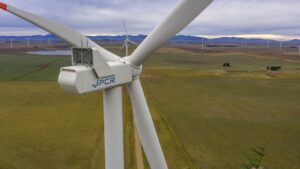
The La Flecha wind farm, located 45 kilometers from Puerto Madryn, completed the installation of the 56 wind turbines planned for the project driven by Aluar in Chubut. With an installed capacity of 336 MW, the complex is consolidated as the largest wind farm built in a single stage in Argentina and is moving towards the testing and commissioning phase prior to its commercial operation scheduled for October.
The completion of the assembly marks the end of one of the most demanding stages of the work and opens the technical verification period of the equipment, electrical systems, and necessary connections to begin to generate renewable energy on an industrial scale.

A large-scale project in Patagonia
The project began to take shape at the end of 2023, when Aluar agreed with Goldwind on the supply of 52 GW165 model wind turbines of 6 MW unit power. Subsequently, four additional units were added, which increased the total capacity from 312 MW to the current 336 MW.
The construction involved a complex international and land logistics. Six ships transported components from China, and then the equipment traveled more than 1,400 kilometers to the site in Chubut.
Among the pieces moved were components weighing up to 127,000 kilograms and blades approximately 82 meters long. The assembly of the last wind turbine completed the installation planned before the originally estimated deadlines by the participating companies.
Less fossil gas and fewer emissions
According to estimates released by the companies involved, the generation of the park will replace around 1.3 million cubic meters of natural gas per day, a volume equivalent to the consumption of about 260,000 homes.
Additionally, the complex would avoid the emission of approximately 580,000 tons of carbon dioxide per year, making it one of the most significant renewable additions of the last years in the country.
The companies also highlighted the work done in terms of safety and environmental management during construction, including training programs, incident prevention, and monitoring of operational deviations.
What changes in the Argentine energy matrix
The operation of La Flecha expands the participation of wind generation in the national electrical system and reinforces the diversification of the Argentine energy matrix.
Furthermore, the project provides new renewable capacity in a region with excellent wind resources, reducing the dependence on fossil fuels to cover part of the electricity demand and contributing to the decarbonization goals of the energy sector.
In industrial terms, the energy generated also has strategic value for Aluar, as it expands the renewable sources associated with its energy operation and improves the integration of long-term electricity supply.
How solar energy is advancing in Argentina
Although La Flecha is a wind project, the Argentine renewable growth also includes a sustained expansion of photovoltaic solar energy. In recent years, large-scale solar parks have been incorporated in provinces such as San Juan, Jujuy, Catamarca, La Rioja, Mendoza, and San Luis, taking advantage of some of the best irradiation conditions on the continent.
In addition to the large parks, distributed generation is growing under the national regime that allows residential, commercial, and industrial users to inject surpluses into the electrical grid through solar panels installed on roofs or own premises.
The combination of Patagonian wind and solar resources from NOA and Cuyo is configuring a more diversified renewable matrix, with greater resilience to climate variations and lower emission intensity per unit of energy produced.
With the 56 wind turbines already installed, La Flecha now enters the decisive stage of operational testing. If the technical schedules are met, the complex will begin to generate commercial energy in the last quarter of the year, consolidating Chubut as one of the main renewable hubs in the country.


