



The province of Chubut announced the construction of a Photovoltaic Solar Park in Paso de Indios, which will mark the end of diesel-based electricity generation in the locality.
The initiative, presented by Governor Ignacio “Nacho” Torres, involves a provincial investment of $8.4 billion and aims to significantly reduce fossil fuel consumption, greenhouse gas emissions, and generation costs.
Torres highlighted that this project constitutes a historic advancement in strengthening the energy supply in the central plateau and will be the first step towards a profound transformation in the way energy is consumed in the province.
Project Features
The Photovoltaic Park will be integrated into a hybrid Smart Microgrid, which will replace the current diesel generator sets. Its main components include:
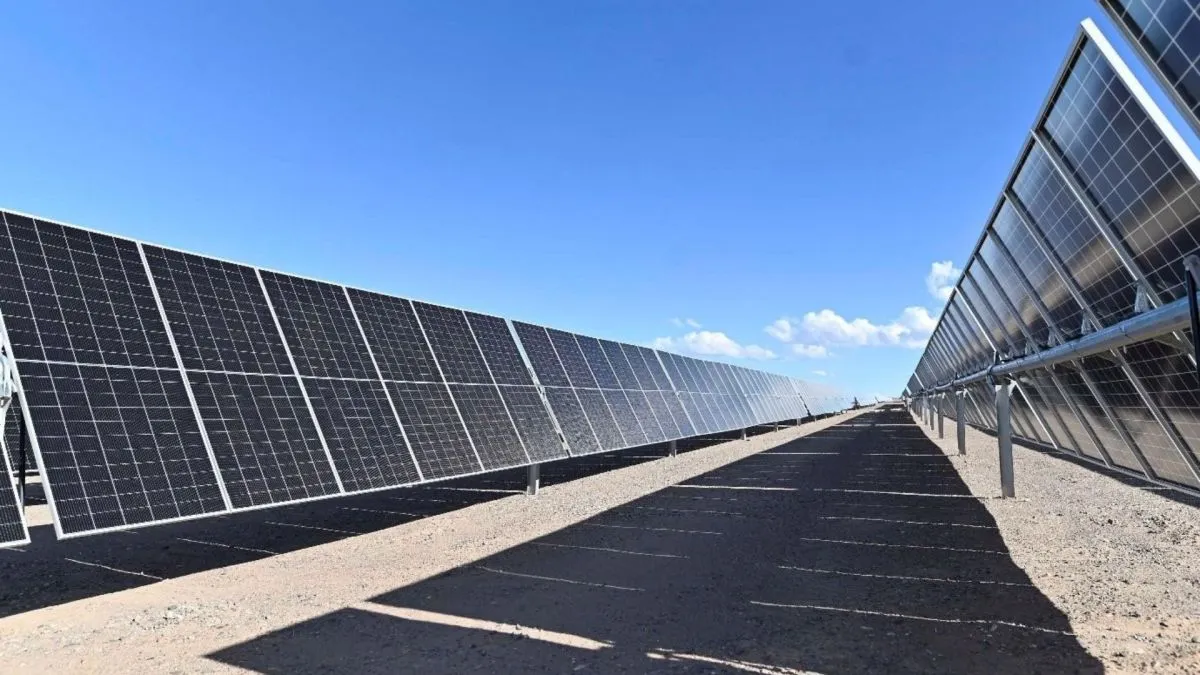
- 4,680 Trina Solar photovoltaic modules of 615 Wp each.
- 130 fixed structures with North-South orientation.
- 8 Huawei SUN2000-330KTL-H1 inverters of 330 kVA.
- Huawei Luna 2000 battery storage system of 5 MWh.
- Transformer station to raise the voltage from 800V to 13.2 kV.
The expected generation will reach 2.8 MWp, with real-time remote monitoring and combustion backup if needed.
Expected Impact
The annual demand of Paso de Indios (3,438 MWh) will be covered through:
- Photovoltaic solar energy: 1,457 MWh.
- Battery storage: 1,251 MWh.
- Combustion generation: 730 MWh.
This will allow for a 20% reduction in fossil fuel dependence, increase the share of renewable energies, and improve the reliability of the electricity supply.
Environmental and Economic Benefits
- Reduction of CO₂ emissions and lower environmental impact.
- Decrease in megawatt cost from USD 570 to USD 150.
- Greater operational and budgetary stability, by decoupling thermal cost from fuel market volatility.
- Energy self-sustainability for historically isolated towns.
A Replicable Model
Governor Torres emphasized that this project will be a pilot case that can be replicated in other municipalities and in the private sector, especially in energy-intensive industries. The construction will begin in June 2026 and is expected to be completed by February 2027, with the construction of a building that will function as the control center of the Photovoltaic Park.
The Photovoltaic Solar Park of Paso de Indios represents a milestone in Chubut’s energy transition, by replacing an archaic and inefficient system with modern, sustainable, and long-term infrastructure. The initiative not only reduces costs and emissions but also strengthens energy security and paves the way for the province to become a national leader in renewable energies.


