



Wind energy has consolidated as one of the main allies in the transition towards a cleaner future. Its ability to generate electricity without emissions and reduce dependence on fossil fuels makes it a key player against climate change. However, behind each wind turbine lies a complex engineering work that seeks to balance efficiency, stability, and sustainability.
For decades, the three-blade model dominated the industry by offering an adequate compromise between aerodynamics, mechanical resistance, and reliability. Each additional blade provides less performance, and adding more than three generates overweight and wind resistance, reducing efficiency. That is why manufacturers have opted for the triad as a worldwide standard.
From a mechanical point of view, three blades allow for distributing loads evenly, reducing vibrations, and extending the lifespan of the equipment. Wind turbines also have Yaw brakes, systems that orient the rotor towards the wind and protect it from extreme gusts, providing an extra layer of safety.
On the other hand, designs with one or two blades historically faced stability and durability issues, requiring additional parts that increased costs and complicated manufacturing. However, recent innovation is challenging this trend and opening up new possibilities to diversify turbine models.
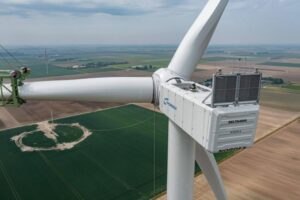 Wind energy.
The challenge of two blades: innovation and efficiency
The company Envision Energy surprised the sector by presenting a two-blade (2B) wind turbine that has managed to overcome traditional obstacles. With over 500 days of stable operation, it achieved levels of availability and operating hours comparable to three-blade models.
This advancement is due to a modular and lightweight design that reduces structural mass and simplifies assembly logistics. It also integrates active controls, lightweight materials such as carbon fiber shafts, and advanced technology to ensure dynamic stability. Thus, the vibration and wear issues that previously limited bi-blade turbines seem to be a thing of the past.
The two-blade model offers clear economic advantages. By reducing the rotor’s weight by 15–20%, manufacturing and transportation costs decrease. It is even possible to mount the rotor and the nacelle together, simplifying operations in remote areas. Although its aerodynamic efficiency may be up to 5% lower, the cost-benefit balance makes it attractive for projects in complex environments.
In emerging markets, where logistical conditions hinder the installation of conventional turbines, this design can make a difference. Its adaptability makes it a strategic option to accelerate the expansion of wind energy in isolated regions and support global commitments to decarbonization.
 Wind energy. Photo: Hybrids and Electric.
The environmental benefits of wind energy
Beyond technological innovation, the true value of wind energy lies in its environmental impact. By generating electricity from the wind, it avoids the burning of fossil fuels responsible for greenhouse gas emissions. Each operational wind turbine can offset thousands of tons of CO₂ throughout its lifespan.
Another key benefit is the reduction of air pollution. Unlike thermal plants, wind energy does not produce smoke, particles, or toxic waste, contributing to improving the quality of life in nearby communities. Moreover, as a renewable and inexhaustible source, it offers energy security in the long term.
The installation of wind farms also promotes local development, creating jobs and fostering more sustainable regional economies. In combination with other clean energies, wind power emerges as one of the most effective solutions to mitigate climate change and build a more just and balanced energy future.
With advances such as two-blade turbines and the consolidation of more efficient models, wind energy reaffirms its role as a driver of ecological transition. Innovation, sustainability, and adaptation to the needs of each territory pave the way towards a world less dependent on fossil fuels and more committed to the planet.



