



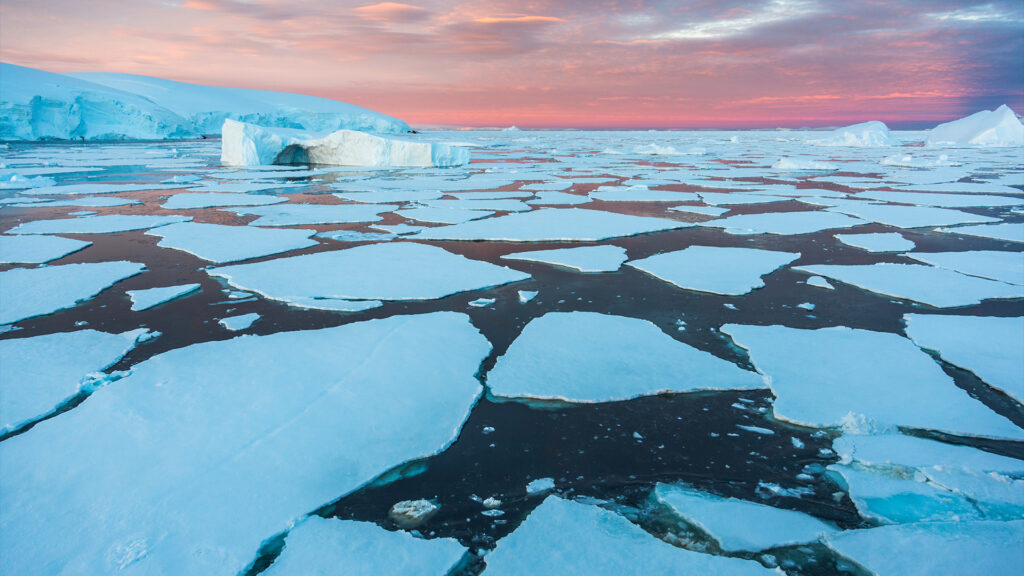
The sea ice surrounding Antarctica is decreasing and continues to set alarming records: year after year, the levels of sea ice in the Antarctic Ocean are shrinking, and experts warn about climate change.
Traditionally, during the southern hemisphere winter, the ocean around the Antarctic continent freezes, extending several kilometers from the coast. This process reaches its maximum between September and October, before starting the spring thaw cycle.
However, this austral winter of 2025, the ice extent barely reached 18 million square kilometers by September 17.
This is the third lowest record since satellite measurements began 47 years ago, as detailed by the National Snow and Ice Data Center at the University of Colorado, Boulder.
Ted Scambos, senior research scientist at the institution, explained that until 2016, there was “a slight erratic increase” in the extent of sea ice in Antarctica.
However, the scenario changed drastically: now “global warming of the ocean is mixing with the water closest to Antarctica,” Scambos explains. This -he points out- shows that climate change has finally reached the most southern seas of the planet.
Ice in the Antarctic Ocean: alarming data
The most concerning aspect is the recent trend: the years 2023, 2024, and 2025 hold the three lowest positions in the historical record, well below the usual averages.
This situation is also repeated in summer: in 2025, the sea ice in Antarctica tied as the second lowest minimum extent ever recorded. Furthermore, the five lowest summer extents recorded occurred between 2017 and 2025.
This concentration of records in such a short period suggests that Antarctica has crossed a critical threshold. What was once considered exceptional anomalies is now becoming the dominant pattern.
The three consecutive winters with the lowest recorded extents (2023, 2024, and 2025) confirm that the white continent is responding more markedly to global warming.
The magnitude of the problem is colossal: the Antarctic ice sheet contains enough frozen water to flood coastal cities around the world.
Although such a catastrophe would unfold over centuries, the process is already underway. One fact illustrates the urgency: 90% of the heat generated by human activities is absorbed by the oceans, accelerating these changes.

Why Polar Ice is Essential for the Planet’s Balance
The reduction of Antarctic sea ice triggers multiple chain reactions. Although floating ice does not directly raise the sea level when it melts, its disappearance generates a dangerous feedback loop.
The white and reflective surfaces that reflect solar energy back into space are replaced by dark water that absorbs that heat, further accelerating warming.
Therefore, sea ice acts as a crucial protective shield, acting as a barrier that prevents the continental ice sheet from sliding into the ocean, which would cause catastrophic sea level rise.
Antarctic sea ice also buffers the impact of waves against the coasts and reduces the influence of winds on oceanic waters.
However, paradoxically, the reduction of sea ice could also generate a partial compensatory effect: according to Scambos, “the moist air over the ocean would be closer to the coast,” allowing storms to transport more moisture to the continent and producing more snowfall that could partially counteract the sea level rise.



