



Amid urban growth and the reduction of green spaces, more and more people are seeking plant species capable of providing biodiversity without requiring extensive care. In this scenario, the cow’s hoof has begun to stand out as one of the most chosen ornamental trees for small yards and gardens.
This species, scientifically known as Bauhinia forficata, combines resilience, abundant flowering, and a strong ability to attract beneficial fauna. Additionally, its moderate size allows it to be incorporated into both urban homes and narrow sidewalks and small spaces.
Its presence also helps to enrich the urban landscape. The violet, white, or pink flowers appear during long periods of the year and transform environments into small biological corridors for birds and pollinating insects.
The popular name of the tree comes from the particular shape of its leaves. Each one has a central opening that resembles the footprint of a cow’s hoof, a characteristic that makes it easily recognizable in nurseries and gardens.
An ecological ally for yards and cities
The expansion of ornamental species adapted to urban environments has begun to be seen as an important tool to recover biodiversity within cities. In this context, the cow’s hoof offers multiple environmental benefits.
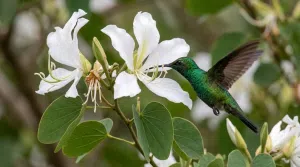
On one hand, its flowers produce abundant nectar, a fundamental resource for hummingbirds and butterflies. Thanks to this, many urban yards become feeding points for various pollinating species that find fewer and fewer natural refuges.
Additionally, its light canopy allows for moderate shade without completely darkening the environment. This favors air circulation and helps to reduce the impact of high temperatures during the warmer months.
Unlike other large ornamental trees, the cow’s hoof can be maintained between 3 and 6 meters in height through gentle pruning. This characteristic facilitates its incorporation into small gardens, urban yards, and even large planters on balconies.
Furthermore, its resistance to periods of moderate drought makes it a compatible alternative with sustainable gardening strategies, where the goal is to reduce excessive water consumption.
What does this tree need to grow in optimal conditions?
Although it is a relatively easy species to maintain, there are some key conditions to ensure healthy growth and intense flowering for much of the year.
The cow’s hoof needs to receive several hours of direct sunlight daily. Specialists recommend placing it in open and bright spaces, as the lack of light significantly reduces the number of flowers.
On the other hand, it requires well-drained soils to avoid water accumulation in the roots. While it tolerates high temperatures and dry periods, excess moisture can affect its development.
Watering should be done moderately. Ideally, wait for the soil to lose moisture before adding water again. In this way, the plant develops greater resistance and stability.
Additionally, light pruning encourages the appearance of new branches and stimulates future flowering. However, during intense winter, it is advisable to protect it from strong frosts, especially in young specimens.

Hummingbirds, flowers, and urban biodiversity
One of the most valued aspects of this ornamental species is its relationship with hummingbirds. The tubular and colorful flowers serve as a constant food source for these birds, which are fundamental in pollination processes.
The presence of hummingbirds also indicates better ecological conditions in gardens and urban green spaces. Where they find food and shelter, they tend to increase other beneficial species for environmental balance.
In times when cities are losing biodiversity at a rapid pace, trees like the cow’s hoof demonstrate how small domestic actions can contribute to building healthier, resilient environments connected with nature.



