



A new study revealed the high levels of water contamination in Entre Ríos. The research found that the sediment of Las Conchas stream showed the highest concentration of glyphosate residues recorded in South America (5002 µg/kg micrograms per kilogram).
The results of this study were presented by the Conicet researcher Rafael Lajmanovich at the Socioenvironmental Health Congress held this week in Rosario. The research will be published soon in the Water Environment Research dissemination magazine.

Extreme pollution in streams
The study evaluated pollution caused by urban, industrial, and agricultural activities in four streams in Entre Ríos (Las Conchas, Espinillo, Crespo, and Las Tunas). These water bodies are tributaries of the Paraná River.
During the research, signs of high pollution were documented. Scientists found agrochemical cocktails, black coloration, putrid odors, dissolved oxygen below critical levels, among other indicators. In tests conducted with tadpoles, 100% of the exposed amphibians died within 24 hours.
The tasks were carried out by an interdisciplinary team comprising professionals from Conicet, the National University of Litoral, INTA, and the National Institute of Limnology.
Scientists had previously identified warnings of the degree of contamination in watercourses from Entre Ríos and Santa Fe years ago. There is a history of studies since 2008 showing contamination and presence of pesticide residues in the streams that flow into the Paraná. This time, a detailed study was conducted on the entire Las Conchas stream basin.
“There is accumulation of substances in sediments, especially glyphosate, which is the marker. That is what we found in the Las Conchas stream, where these streams converge. There the water is not as contaminated; it accumulates in the sediments,” explained Lajmanovich to the Análisis portal.
In the sediments of Las Conchas stream (located within the San Martín Park natural reserve), 5002 µg/kg micrograms per kilogram were found, representing the highest concentration level of glyphosate recorded in South America.
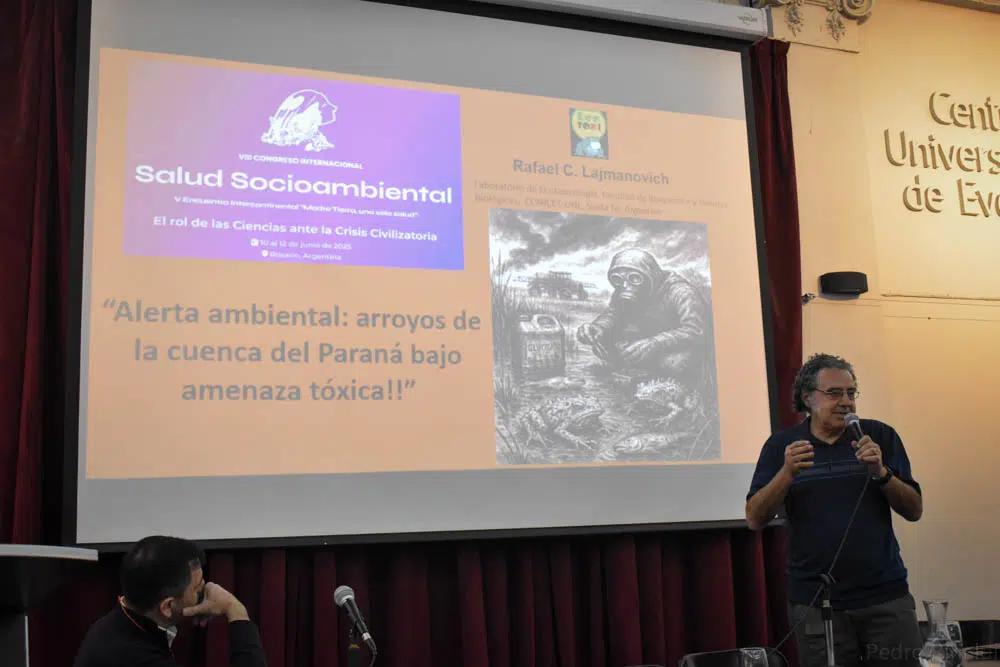
In the research paper, scientists highlight the alarming environmental degradation. Likewise, the need for sustainable agricultural practices and control actions to protect and restore freshwater sources is emphasized. These tasks are urgent considering that the most productive region known as the Argentine Pampa is identified as a critical point of glyphosate at a global scale.
Socioenvironmental quote
This research was presented at the VIII Socioenvironmental Health Congress, held between June 10 and 12 in Rosario. Over fifty scientists and researchers gather at this event under the theme of this edition, “The Role of Sciences in the face of the Civilizational Crisis.”
“At a crucial moment in history, the civilizational crisis challenges us to rethink our models of coexistence, production, and science. That is why our approach is based on cooperation and collective construction of solutions for the environmental, social, and health challenges we face globally,” stated Dr. Damián Verzeñassi, director of the Institute of Socioenvironmental Health (InSSA) and president of the VIII Congress.


