



Last Sunday, Argentina marked a milestone in its energy transition: renewable sources supplied 44.28% of the national electricity demand. This is a new historical record in the country’s clean energy generation.
According to official information from CAMMESA, at 12:50 PM, almost half of Argentina’s electricity came from clean energies.
This aligns with the Law 26.190, which establishes a national promotion regime for the use of renewables in Argentina.
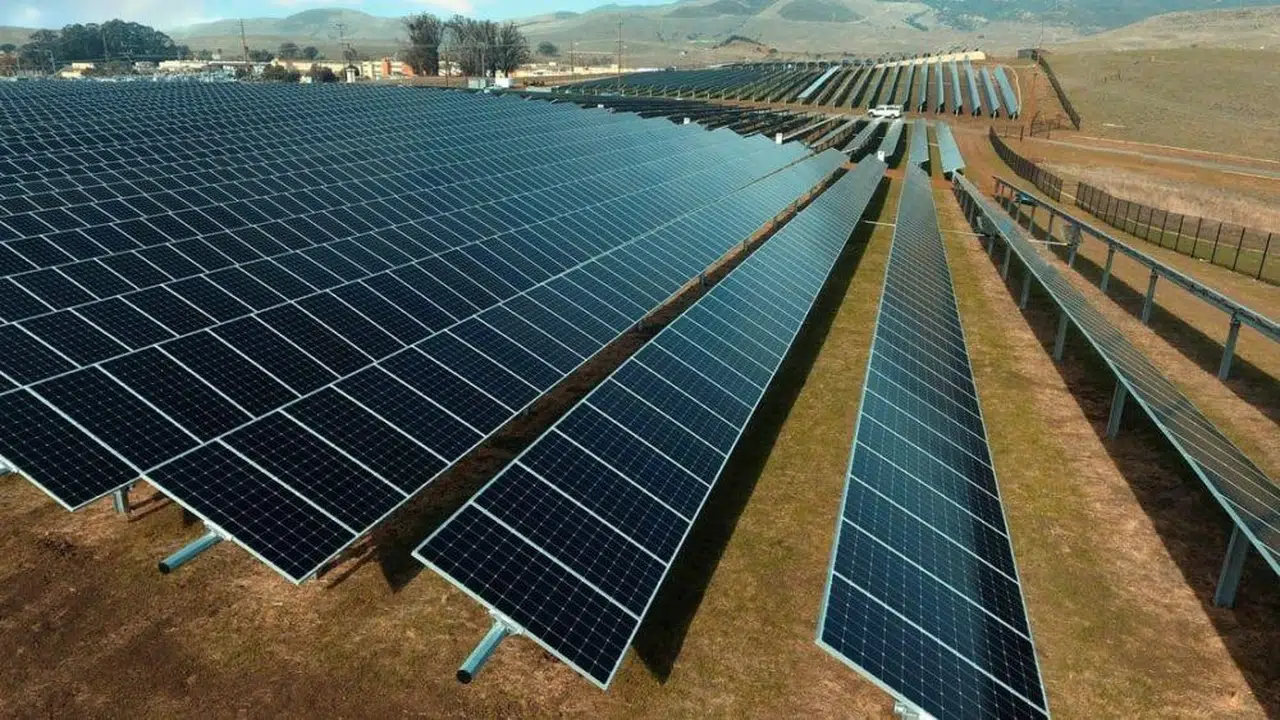
At that specific moment, wind energy contributed 3495 MW, while photovoltaic solar generated 2015 MW.
Additionally, 233 MW from small hydraulic developments and 154 MW from bioenergy contributed to the total.
An additional relevant fact: wind and solar generation covered 41.4% of the demand, setting a historical record in variable sources.
Moreover, CAMMESA data also reveals that, in the “Argentina + Uruguay” region, the combined variable renewable participation reached 6,061 MW.
This represents 41.9% of the demand of both interconnected systems.
This result reflects technical advances and a significant level of regional energy integration between both countries.

Record of renewable energy use in Argentina: the data behind it
CAMMESA data shows that, by the end of 2024, the renewable capacity reached 6,670 MW in the Wholesale Electricity Market.
However, the demand coverage had been stagnant around 16-17% during the previous months.
Thus, although the jump to 44.28% represents a significant quantitative advance, it is also necessary to emphasize that it is a moment of low demand.
In particular, the deployment of large wind and solar parks, combined with optimal wind and radiation conditions that day, enabled the record combination.
Thus, a context of moderate demand allowed variable sources to gain participation in the national electrical system.
Diversification with small hydraulic developments and bioenergy also helped achieve the renewable energy record.
In general, when calculating the annual average use, the scenario is more modest: the effective renewable coverage for 2024 closed near 16.3% of the demand.
The milestone is encouraging, but it does not mean that the system is already at that permanent level of renewable penetration.
According to CAMMESA reports, the accumulated variable renewable generation in the first quarter of 2025 reached 6,209 GWh, just 9.9% more than in 2024.
Renewable energies in Argentina: the pending challenges
Despite the renewable energy record, transmission problems, curtailment, and the need for thermal backup when variable sources decrease their production still persist.
The infrastructure of high voltage lines, regional interconnection, and massive storage also continue to create a bottleneck for the system.
Additionally, there is concern that new additions of renewable capacity have slowed down, according to official data from the first quarter of 2025.
Renewables in Argentina: the current legal framework
This achievement occurs within the framework of Law 26.190 and its modifications, such as Law 27.191.
In particular, these establish that by December 31, 2025, renewable sources must cover at least 20% of the country’s total electricity consumption.
This regulation includes a national promotion regime, a trust fund for development, and tax benefits for investors in the sector.
Everything indicates that this limit will be extended again, as reaching the threshold will be more of a minimum step than a ceiling.
Thus, the recent record demonstrates that the system has momentary capacity, but the reality is that consolidating a sustainable renewable coverage above 30% will require more investment.
Today, the goals of the renewable law are at risk if the installed capacity is not accelerated.


