



The government of Tierra del Fuego, Antarctica and South Atlantic Islands launched a strong warning against vessels from China, Spain, and South Korea, accused of illegal incursions in Argentine jurisdictional waters. The actions, detected near the Falkland Islands, raised alarms due to the plundering of natural resources and the indirect reinforcement of British presence in the occupied archipelago.
Provincial authorities formally lodged complaints with the embassies of these countries. The request aims not only to stop unauthorized fishing but also to denounce the strategic risk posed by uncontrolled extractive activities in the South Atlantic.
The conflict also involves Taiwanese-flagged vessels, leading the province to reiterate its adherence to the “One China” principle and reject any recognition of separatist entities, in line with Argentine foreign policy.
Thanks to a recent agreement with the Coast Guard, Tierra del Fuego has incorporated real-time monitoring technology, which allowed the detection of illegal incursions and activated diplomatic channels. Authorities assured they will pursue legal actions to penalize the involved companies.
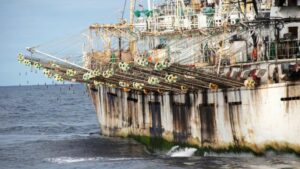
 Authorities of Tierra del Fuego, Antarctica and South Atlantic Islands denounce illegal fishing.
Environmental and Political Consequences of Illegal Fishing
Illegal fishing not only depletes marine resources but also contributes to the degradation of entire ecosystems. Unregulated massive catches cause imbalances in biodiversity, affecting both target species and associated food chains.
This depredation compromises the sustainability of oceans and jeopardizes local economies dependent on artisanal or regulated fishing. Moreover, it diminishes the ecosystems’ regenerative capacity, impacting future generations.
In the case of the Malvinas, illegal fishing not only means a loss of natural resources but also provides indirect economic support to British occupation, as it strengthens the presence of economic actors operating without Argentine control.
Global Implications of Illegal Fishing
Illegal, unreported, and unregulated (IUU) fishing constitutes one of the world’s major environmental scourges. According to the FAO, it represents up to 26% of global catches, mainly affecting developing countries with weak maritime control capacities.
In addition to the ecological impact, illegal fishing fosters abusive labor practices and in some cases is associated with trafficking networks and corruption. The economic losses are staggering, affecting both states and coastal communities.
The oceans, considered the Earth’s lungs, face increasing pressure due to overfishing, climate change, and pollution. Unregulated fishing accelerates this process and jeopardizes marine ecosystem health.
A Threat to Sovereignty and the Environment
Foreign fleet incursions into Argentine waters reveal not only an environmental crime but also a threat to national sovereignty. The lack of coordinated responses between provinces and the Nation weakens the country’s ability to protect its natural resources.
The impact of this indiscriminate fishing also hits local communities, witnessing their economic activities suffer from unfair competition from large foreign fleets operating outside the law.
Defending natural resources in the South Atlantic requires a firm and sustained foreign policy, coupled with effective controls at sea. The plundering of fisheries is evidence that sovereignty is also defended in environmental and economic realms.
Argentina faces the challenge of developing strategies to protect both its territory and natural heritage, remembering that uncontrolled exploitation of marine resources is a direct threat to the planet’s balance and the future of upcoming generations.



