



More than twenty **environmental organizations** warn that a new proposal for **Land Use Planning Code** endangers both **water supply** and public health, as it authorizes the **destruction of wetlands** in the midst of a scenario of **climate change** and **frequent droughts**.
A collective of **social and environmental entities** has issued a serious **warning** about the potential **consequences** of a new draft of the **Land Use Planning Code** (COT) for the district of **Escobar**.
According to these groups, including **SOS Habitat**, the proposal, promoted by the **municipal government** and sent to the **Deliberative Council**, goes against current legislation and facilitates wetlands destruction.
This situation, they point out, could exacerbate **water scarcity** and **water contamination** issues in the area.
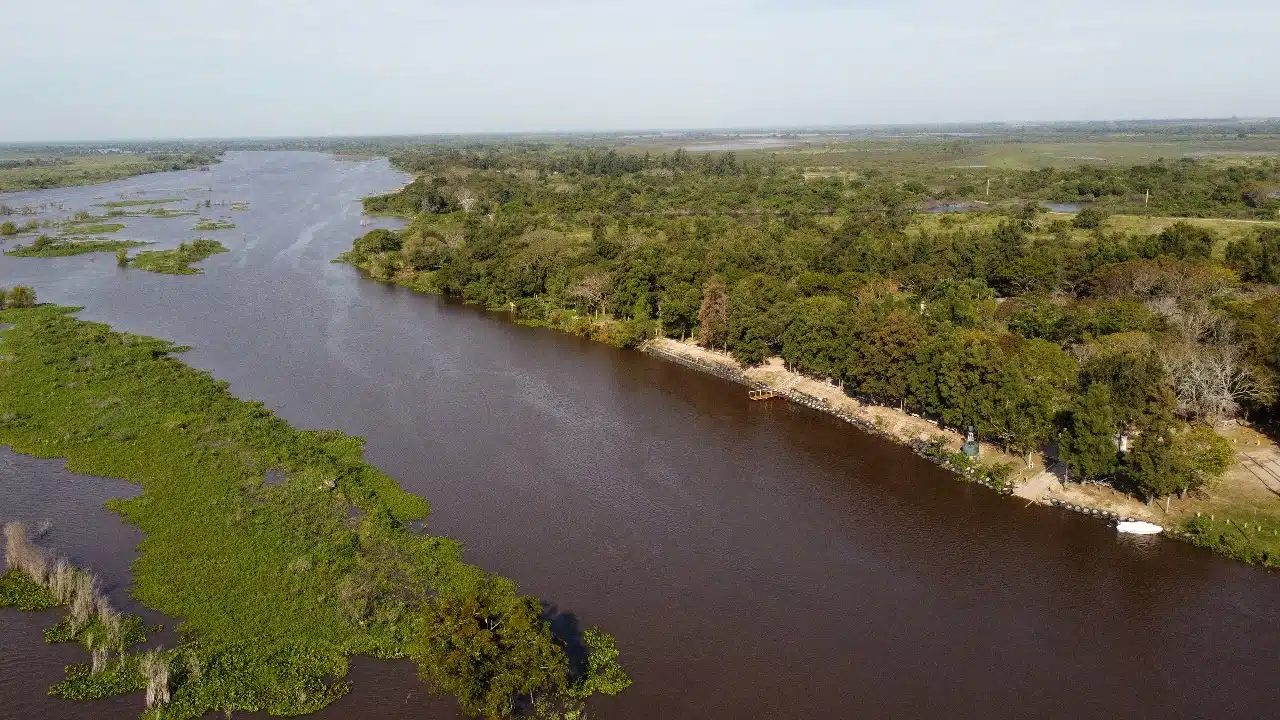
A scenario of water crisis and lack of planning
The organizations emphasize that **80% of the population** and **economic activity** in Escobar depend on groundwater reserves. The remaining 20% is supplied by the **Paraná de las Palmas River**, whose waters are also under significant pressure.
This warning becomes particularly important in the context of a global water crisis, exacerbated by climate change.
Experts indicate that the planet’s **freshwater** is decreasing at an unprecedented rate. This reality has become evident in **Escobar** and its surroundings with the **extensive drought** that took place between 2020 and 2023, and has continued throughout 2024 and 2025.
The condition of the **Paraná de las Palmas River** is a source of special concern. The constant low **water levels** not only reduce the available quantity but also increase the concentration of **contaminants** such as untreated **sewage effluents**, **agrochemicals**, **plastics**, and **industrial waste**, complicating the water **purification** process.
Destruction of wetlands at risk, “contradictory” measures
**Ecologist collectives** affirm that **wetlands** play a fundamental role in the **hydrological cycle**. They act as “sponges” that absorb and moderate water flow, and act as “natural kidneys” by purifying it.
Despite this relevance, both the current Land Use Planning Code in **Escobar** and the new proposal, as denounced by the **organizations**, enable the annihilation of these **ecosystems** to make way for **urban and industrial projects**.
The works involving **landfills** and construction of **embankments** are carried out, they claim, without the necessary **cumulative environmental impact studies** and without the **public consultation** required by law.
To highlight the **consequences** of these policies, the groups mention the example of the neighboring district of **Tigre**. This district, which was one of the first to eliminate its **wetlands**, now needs to use a water intake located in **Escobar** to supply this **resource** to its inhabitants.
The organizations urge authorities to take **urgent measures** to protect **water sources**, both underground and surface, and **wetlands**, as they are essential to ensure the **water security** of the community. In order to give more visibility to their demand, they have started a **signature collection campaign** through the platform Change.org.



