



In the last year, Argentina generated around 25 million tons of industrial waste, but only 4% was managed by authorized handlers and directed to recovery, treatment, or safe final disposal processes. The rest, more than 90%, ended up in open-air dumps or informal circuits, reflecting a structural crisis in the country’s environmental policy.
Open-air dumps: centers of health and environmental risk
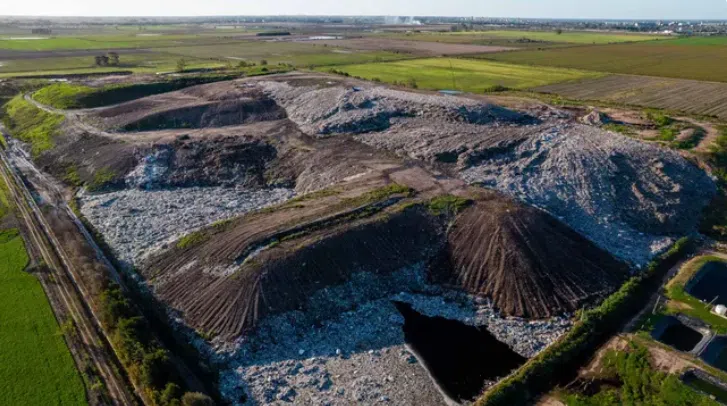
According to data from the National Subsecretariat of Environment and the COFEMA, there are between 5,000 and 5,400 open-air dumps throughout the territory. In these sites, waste is mixed, burned, and leached into the soil, water tables, and air without any containment.
These spaces constitute contamination hotspots that directly affect millions of people. According to specialists, they represent one of the most serious problems of Argentina’s environmental policy.
The Argentine Chamber of Industrial and Special Waste Handlers and Transporters (CATRIES) warns that these sites are an environmental setback and a direct risk to the health of nearby communities. The latest measurement, conducted in 2025, confirmed that only 4.07% of industrial waste received proper treatment, while the rest accumulated in informal spaces.
A growing problem out of control
The absence of formal management practices by thousands of companies and the State itself fuels the growth of dumps. Waste is dumped there without separation or treatment, mixing household, bulky, industrial, and even hazardous waste.
The consequences are severe:
- Toxic leachates that contaminate soil and water.
- Methane emissions that contribute to climate change.
- Open-air burning that releases dioxins and furans, highly harmful to health.
The expansion is evident:
- Santa Fe: about 400 informal dumps.
- NOA: more than 600 in Jujuy, Salta, and Santiago del Estero.
- Tucumán: critical in the metropolitan area of San Miguel, with more than 1,600 tons daily without sanitary conditions.
- Entre Ríos: Concordia is a critical point due to volume and urban proximity.
- Buenos Aires: emblematic cases like the Luján dump (closed in 2021) and clandestine dumps in José León Suárez.
Sanitary landfills: a safe alternative
In contrast, sanitary landfills represent a safe and controlled final disposal. In Argentina, around 70 authorized landfills operate, concentrated in Buenos Aires, Córdoba, Mendoza, Santa Fe, and Tucumán.
These facilities feature:
- Technical design and cell impermeabilization.
- Leachate collection and treatment systems.
- Water table monitoring and permanent environmental control.
“The cell of a sanitary landfill is a compartment covered with a membrane that prevents direct contact of the waste with the soil. It also has a leachate collection system for treatment. The entire site operates under environmental standards, with daily monitoring and constant oversight,” explains Claudia Kalinec, president of CATRIES.
The challenge: a paradigm shift
The gap between the more than 5,000 informal dumps and the 70 authorized landfills highlights the urgency of moving towards an integrated waste management system.
The country faces a dual challenge:
- Reduce waste generation at the source.
- Promote a transition towards integrated management models, with separation, recycling, recovery, and properly operated sanitary landfills.
“Managing waste well is not a luxury, it is a basic condition to protect health and the environment,” concludes Kalinec.
Argentina needs a paradigm shift in waste management. Open-air dumps are the most critical face of a system that still fails to guarantee environmental or sanitary safety. Sanitary landfills show that there are technical solutions and successful experiences, but the key is to replicate them on a national scale with sustained political determination.



