



The Sembrando Futuro 2.0 project is consolidated as an innovative initiative in Latin America. Its approach integrates the recovery of ecosystems with the active participation of rural communities.
Since its launch in September 2023, the program has successfully reforested more than 1,000 hectares. Additionally, it plans to restore more than 2,000 hectares in key regions of the country.
In this regard, the initiative is being developed in the departments of Antioquia, Caldas, Risaralda, Córdoba, and Chocó. Thus, it covers strategic territories for biodiversity.
An international recognition of the model
The project received an “A” rating from Sylvera, standing out in the international carbon market. This recognition validates its environmental and social impact.
Furthermore, its capacity to generate measurable and verifiable carbon capture was valued. Therefore, it positions itself as a key tool against climate change.
Additionally, the technical design and long-term planning were determining factors. Consequently, the model demonstrates that it is possible to combine rural development with sustainability.
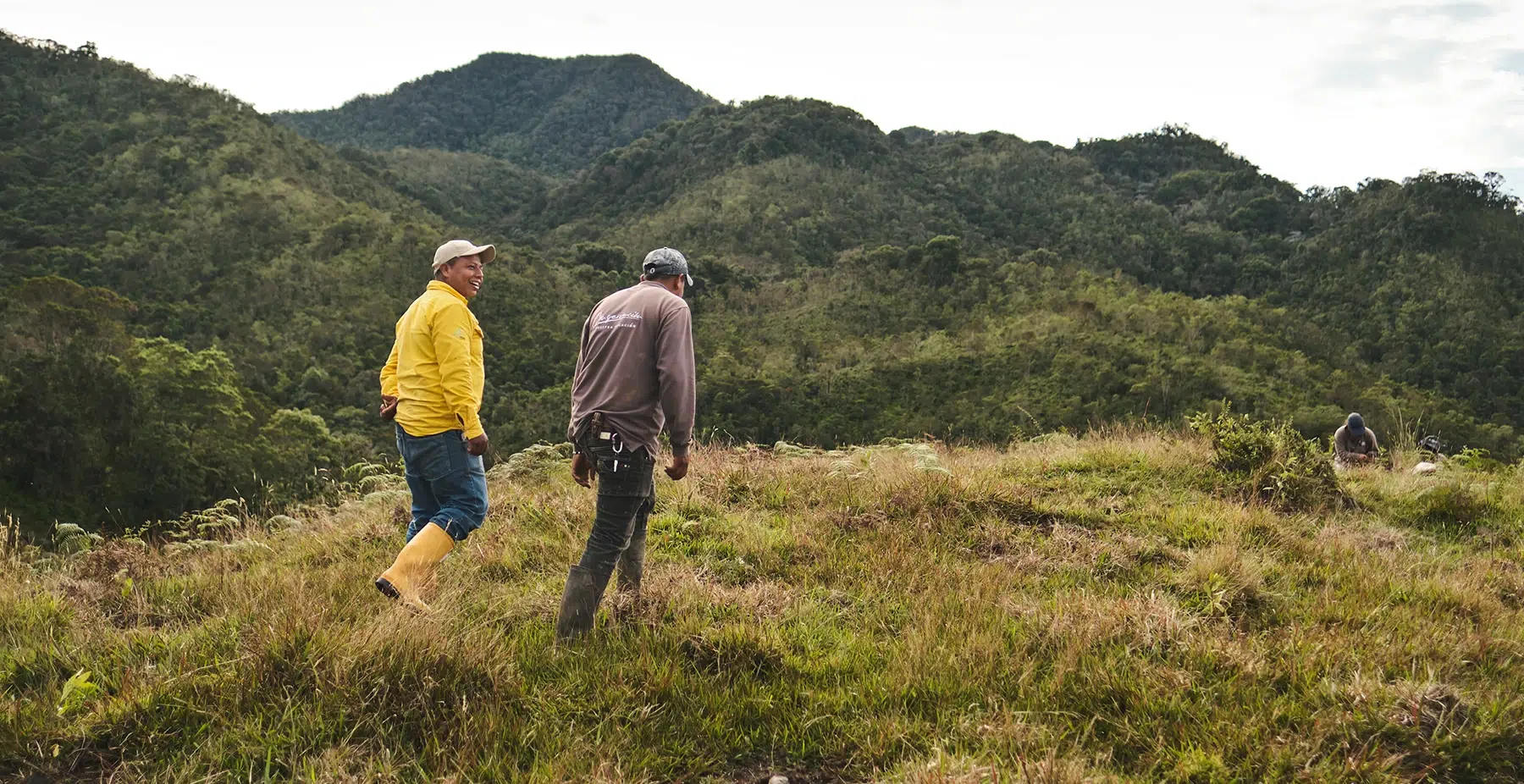
Productive reforestation and long-term agreements
One of the pillars of the project is the signing of conservation agreements for 40 years. These commitments involve small producers and landowners.
Through these agreements, communities receive about 55% of the income generated by carbon credits. In this way, an economic incentive is created to protect the forests.
So far, 25 agreements have been signed and more than 240 local jobs have been generated. Consequently, environmental restoration also becomes a productive opportunity.
Biodiversity and native species in recovery
The program promotes the planting of more than 70 native species. Among them, nine species are listed as threatened by the International Union for Conservation of Nature.
This plant diversity strengthens ecosystems and improves their resilience. Additionally, it contributes to recovering essential habitats for local fauna.
Therefore, the restoration not only captures carbon but also revitalizes biodiversity. Thus, comprehensive environmental benefits are generated.

The role of the project in global climate action
Behind this initiative are the Fundación Grupo Argos and Terraformation. Both promote nature-based solutions.
In this context, forest restoration positions itself as a key strategy to mitigate climate change. Additionally, it strengthens the environmental security of the regions.
At the same time, the model demonstrates that climate action can generate economic benefits. Consequently, it encourages a transition towards more sustainable economies.
The Sembrando Futuro 2.0 project and its benefits
The impact of the program transcends the environmental. Firstly, it promotes rural development through employment and community participation.
Additionally, it improves soil quality and regulates water cycles. This favors agricultural productivity and reduces environmental degradation.
On the other hand, carbon capture helps to reduce global emissions. In this way, the project integrates into international efforts against global warming.
Finally, the model strengthens environmental awareness in communities. Thus, a more balanced relationship between people and nature is built.



