



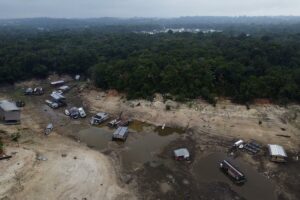
Between September and October 2023, an unprecedented heatwave disrupted rivers and lakes in the Brazilian Amazon. In Lake Tefé, boats were stranded and thousands of fish died within days.
Images of lifeless pink dolphins spread worldwide as a climate alarm signal. The extreme temperatures affected riverside communities that depend on the lake for food and transportation.
The heat was felt on every surface: the water, the sand, and the air reached scorching levels. For many families, it was the most severe environmental event in decades.
A recent study confirmed the magnitude of the phenomenon. The research revealed that Lake Tefé reached 41 °C at the peak of the drought. This is a value above the tolerable threshold for most aquatic species.

A freshwater system in rapid collapse
The scientific work, led by a Brazilian institute, combined field monitoring and satellite analysis. The images allowed for the reconstruction of three decades of thermal changes in the Amazonian lakes.
The conclusion was clear: warming is advancing at an unprecedented rate. Five of the ten lakes studied exceeded 37 °C during the day. The most extreme case was Tefé, with a never-before-seen record of 41 °C. In tropical lakes, the usual temperature barely ranges between 29 °C and 30 °C.
The retreat of surfaces was also dramatic. In Tefé, the lake lost 75% of its area; in Badajós, the decline reached 92%. The combination of low water levels and extreme heat accelerated environmental deterioration.
A trend that now encompasses the entire basin
Satellite data from 24 lakes showed that 2023 was not an isolated episode. Since 1990, the average temperature of Amazonian waters has increased between 0.6 °C and 0.8 °C per decade.
Lakes like Tapajós, Amanã, and Janauacá are among the fastest warming. Researchers warn that there is a significant monitoring deficit in the region. Despite its environmental richness, the Amazon has few continuous measurement instruments.
This limits the ability to anticipate extreme events and protect riverside communities. Specialists in tropical rivers point out that the phenomenon reveals a critical ecological limit. The warming of aquatic systems indicates that ecosystems are losing resilience. The region is approaching irreversible scenarios if adaptation policies are not strengthened.
The human impact and the urgent call for cooperation
The 2023 drought left deep consequences for local communities. The fish mortality affected the food supply, transportation, and economy of thousands of families. The deterioration of the water generated health and environmental concerns throughout the region.
The alert from fishermen about the death of dolphins led to the scientific investigation. Their participation demonstrated the importance of local knowledge in detecting critical events. Experts agree that science and communities must work together.
In international forums like the COP30, researchers are promoting the expansion of environmental monitoring. The Amazon is considered a sentinel system of the planet and an early indicator of collapse. If its aquatic ecosystems reach extreme limits, the impact will be global.
Benefits of an initiative based on monitoring and cooperation
Strengthening environmental monitoring allows for the anticipation of droughts, heatwaves, and wildlife mortality. Detecting variations in water temperature helps design quick and effective responses.
This prevents losses of biodiversity and irreversible damage in sensitive ecosystems. The collaboration between science and communities generates solutions more adapted to each territory. Local knowledge complements technical data and improves the accuracy of strategies.
Moreover, it strengthens citizen participation in the protection of their own water resources. At the regional level, this initiative promotes more robust climate adaptation policies.
A coordinated monitoring system facilitates cooperation among Amazonian countries. Protecting tropical lakes means protecting the environmental stability of the entire basin. The Amazon sends a strong signal: without monitoring, the region remains blind to climate change.


