



In the northwest corner of Santa Cruz, Parque Patagonia has become a model of large-scale ecological restoration. With the impetus of the Rewilding Foundation, the area has made progress in the recovery of native species and the restoration of the natural balance lost after decades of human pressure. The proposal also focused on an economic development based on sustainable tourism.
Within its 180,000 hectares, the park has been home to iconic species of the steppe such as guanacos, choiques, viscachas, and condors, and has served as an occasional refuge for pumas, foxes, and smaller mammals. Thanks to the constant work of technicians, veterinarians, and volunteers, the advance of invasive exotic species has been reversed, and the area has been kept free of domestic animals.
The recovery of wetlands and rock walls allowed for the reintroduction of southern gallinules, coypus, and viscachas. Simultaneously, the conservation of the Andean condor, the puma, and the guanaco was promoted, highlighting their ecological value and their potential as a tourist attraction for visitors interested in wildlife.
 The Andean condor is one of the species that can be found in Parque Patagonia.
A New Nature-Based Economy
The growth of Parque Patagonia has also benefited nearby communities such as Los Antiguos, Perito Moreno, and Bajo Caracoles. Through ecotourism, new sources of income have emerged without competing with traditional activities. Training in hospitality, gastronomy, and nature guides was offered, expanding employment opportunities with a local imprint.
Educational programs engaged young people and adults in conservation. Talks were organized in schools, interpretive camps, and excursions that strengthened the bond between residents and their natural environment. The goal was to build an environmental culture that transcends generations.
The park, with its deep canyons, basalt plateaus, and skies crossed by condors, offered a unique experience of connection with nature. There, each sighting — of an elusive puma, a migrating guanaco, or a flock of summer birds — became a reminder of the value of conserving what remains intact.
A Project with History and Future
The idea of creating Parque Patagonia arose in response to the threat of extractive projects in key areas for endangered species, such as the hooded grebe. Since 2007, various organizations and locals have pushed for its protection. Strategic lands were acquired to be donated to the State in 2012, and the National Park creation law was enacted in 2014.
Since then, new reserves and public access gateways have been added. The Cañadón Pinturas Gateway, for example, offers trails to the Cave of Hands, a UNESCO World Heritage site, and allows visitors to explore unique landscapes while observing animals in the wild. In 2021, the construction of an interpretation center and planetarium began to enhance the educational experience.
With recovering species, involved communities, and conscious visitors, Parque Patagonia has shown that conservation can be a powerful tool to restore not only biodiversity but also the connection between people and their land.
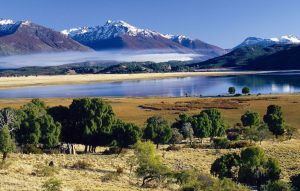
What are the features that make Patagonia a unique region?
Argentine Patagonia has historically stood out for its vastness, low human intervention, and variety of landscapes, making it a key refuge for numerous native species. Its extreme environments, ranging from arid steppes to deep canyons and volcanic plateaus, have favored the evolution of fauna and flora highly adapted to rigorous climatic conditions.
This region hosts endemic or endangered species such as the hooded grebe, the huemul deer, the orange viscacha, and the Geoffroy’s cat. It is also the scene of important ecological processes, such as the seasonal migrations of guanacos and the presence of the Andean condor, soaring over its skies in search of food in vast open areas.
In addition to its biodiversity, Patagonia maintains relatively intact ecological systems, allowing for successful conservation projects and species reintroductions. This unique combination of geographical isolation, biological richness, and low population density positions it as a key region for ecosystem restoration in South America.


