



A team of Japanese scientists has presented a plant-based plastic that completely dissolves in seawater within hours, leaving no solid residues or persistent microplastics.
The breakthrough was led by Takuzo Aida at the RIKEN Center for Emergent Matter Science, and it directly targets everyday packaging, especially those that often escape waste management systems.
The innovation behind the material
The starting point is cellulose, the most abundant natural polymer on the planet. The researchers used carboxymethyl cellulose, a derivative already produced on an industrial scale.
The key was applying ionic polymerization, a process that allows the plastic to form in water, at room temperature, and without harsh solvents.
The material is held together by ionic bridges, temporary electrostatic bonds between opposite charges. In the presence of sodium and chlorides, as occurs in seawater, these bonds weaken, and the plastic dissolves into soluble components.
To prevent this from happening prematurely, a very thin barrier coating is incorporated to ensure its normal, but not indefinite, shelf life.
Properties and applications
The initial versions were rigid and brittle, so choline chloride was added as a plasticizer. With adjustments in the formulation, the material can behave like a rigid sheet or a flexible film.
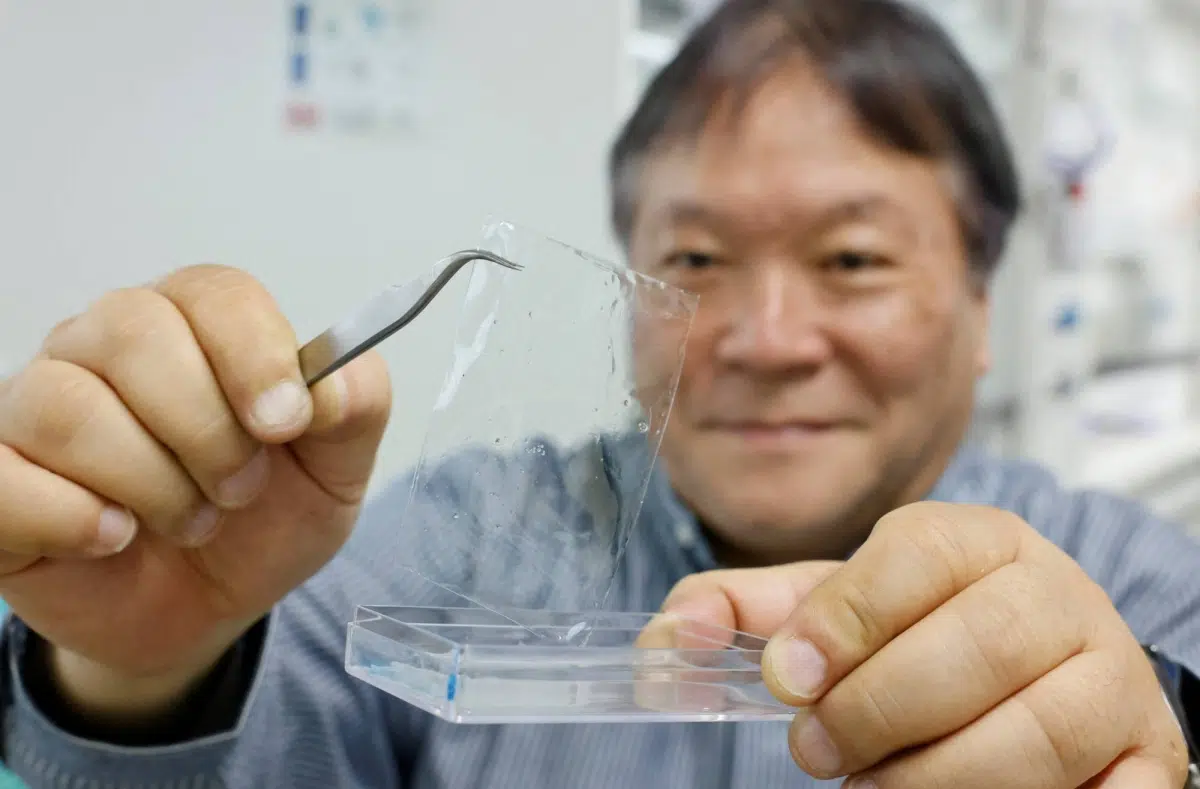
In mechanical tests, some versions achieved elongations of 130%, compatible with lightweight packaging. Transparent films of 0.07 mm thickness, similar to conventional plastics, were also produced.
To demonstrate its practical utility, the team manufactured a lightweight bag capable of carrying tomatoes without breaking. This type of packaging is one of the main sources of marine pollution, so solving this issue has a significant impact.
Differences from other bioplastics
The major innovation is that the material does not progressively fragment but molecularly dissociates, blocking the path to microplastics. Once dissolved, all surfaces are exposed, accelerating natural chemical reactions that take years in solid materials.
Additionally, the system is recyclable in a closed loop: the dissolved components can be recovered by adding an electrolyte that reunites them, allowing the same material to be manufactured again without resorting to new raw materials.
Challenges and perspectives
Dissolving quickly in the sea does not mean that is the goal. It is a safety net, not a management model. For recycling to work, collection systems are needed to prevent material dispersion.
Many bioplastics labeled as compostable only degrade in industrial facilities, while in the ocean, they can remain almost intact for years. Here, the trigger is salinity, which also opens degradation scenarios in wet landfills or saline soils.
The manufacturing process, based on water and without harsh solvents, reduces part of the environmental impact of the plastic industry, although it still requires energy for drying and processing. Scaling this material will require stable supply chains, consistent industrial processes, and waste management regulations adapted to reality.
The future of plant-based plastic
If it manages to overcome the scaling phase, this plant-based plastic could offer something unusual: durability during use and rapid disappearance when the management system fails. Its main contribution is to prevent the accumulation of microplastics in marine ecosystems, reducing pressure on fauna, sediments, and food chains.
The use of plant-based raw materials and aqueous processes decreases dependence on fossil resources and harsh chemicals, providing a more sustainable alternative. In coastal, tourist, or agricultural contexts, where the loss of lightweight packaging is common, this type of material can become an environmental buffer that limits damage when prevention is not enough.



