



From the hand of the Ministry of Ecology of Misiones, this year the province embarked on a program in which they transform seized wood into furniture for schools.
In other words, they reuse supplies that were confiscated from operations such as illegal logging to make essential furniture. Recently, authorities announced that more than 500 products have already been manufactured.
The initiative, called “Essential Transformation“, also combines social inclusion, as those who build are individuals deprived of their liberty, who receive special training for the task.
A project with a triple impact in Misiones: environmental, social, and economic
The program transforms an environmental problem into a tangible solution. It seeks to give a new purpose to resources at risk of decomposition, train individuals deprived of their liberty, and provide furniture to local institutions.
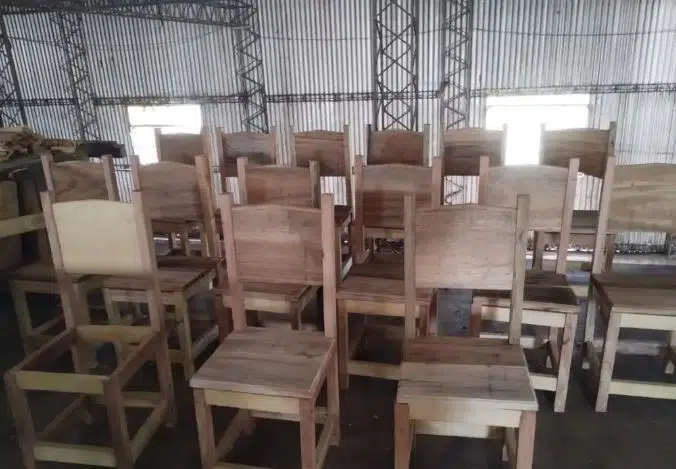
The production of tables, chairs, and beds takes place in the carpentry workshops of the Provincial Penitentiary Service in Eldorado, Loreto, and Oberá.
In these workshops, inmates participate in job training programs, learning trades under state supervision.
Diego Graz, auditor of the Ministry and program manager, explained to Canal12misiones.com that the project was born after a survey detected a large amount of seized native wood. The material, in this sense, includes valuable species such as lapacho, zata, and guayubira, which were at risk of being lost. The decision was clear: “Turning illegality into a social contribution”.
Projections and continuity of the program
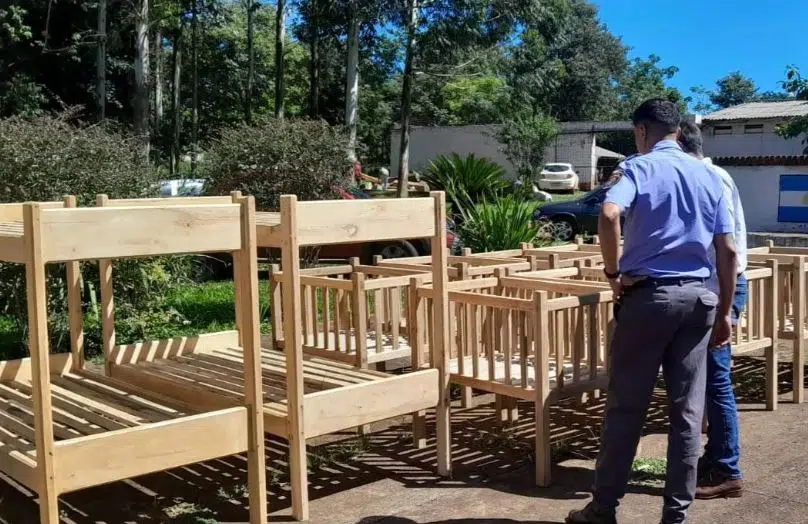 More than 500 pieces of furniture have already been made with seized wood. (Photo: Ministry of Ecology Misiones).
The official highlighted that the program is directly supervised by the Ministry of Ecology, ensuring transparency and control.
Furthermore, he reported that there is still wood in reserve, which will allow production to continue in the coming months and expand deliveries to more schools, social organizations, and vulnerable communities.
The Minister of Ecology, Martín Recamán, emphasized that this policy of innovation, dialogue, and territorial presence is one of the central axes of management that will be deepened in 2026. In this context, the 2026 budget of the portfolio was presented with a 15% increase compared to the previous year.
“Essential Transformation demonstrates that what once represented an environmental damage can be transformed into collective well-being,” Graz concluded, highlighting the value of cooperation between the Ministry and the Provincial Penitentiary Service with a focus on sustainability and social inclusion.
The Essential Transformation program
The project arose from an agreement signed between the Ministry of Ecology and the Provincial Penitentiary Service, which is under the Ministry of Government, in March of this year.
At that time, the Civil Protection Subsecretariat received the first batch of tables, chairs, bunk beds, and cribs made by inmates who are under the supervision of the SPP and participate in carpentry workshops.



