



In the face of the unprecedented heatwave in the northern hemisphere this season and the need for sustainable solutions, a Swiss invention offers a promising alternative. They created a brick that cools up to 9°C in cities, made of terracotta.
Two students from the Zurich University of the Arts, Andrin Stocker and Luc Schweizer, developed Bloc.
It is a modular terracotta block that can reduce the temperature even in urban areas without shade. This innovative design has been a finalist in the prestigious James Dyson Award.
Inspiration from ancestral wisdom and nature
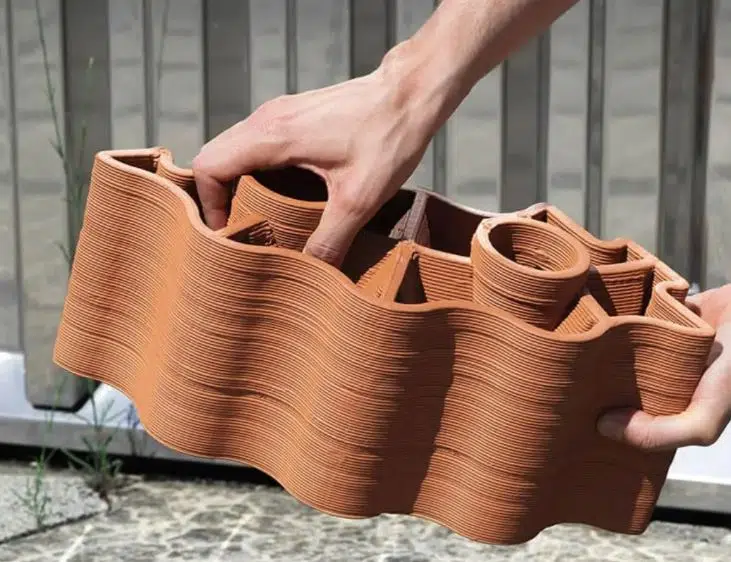 The innovative brick created by Swiss students. (Photo: El Español – James Dyson Award).[/caption>
Bloc is a response to the problem of urban heat islands. Its creators were inspired by passive cooling methods, such as terracotta pots and Persian badgirs (wind catchers).
Their goal is to improve the habitability of cities during extreme heat without resorting to complex technology or excessive energy consumption.
The system works with evaporative cooling, a process that cools the air as it passes through a wet surface. The key lies in its components:
- 3D-printed terracotta: the ceramic bricks are porous and absorb water.
- Solar energy: A solar panel powers a fan and a water pump, allowing the system to operate autonomously.
- Water: it can be supplied through the municipal network or an integrated rainwater collection system.
According to the creators, on hot days above 30°C, the brick consumes about 50 liters of water, while the solar panel generates approximately 200 Wh, enough for its operation.
Unique advantages of the brick and next steps
Although there are other bricks with similar functions, Bloc stands out for its design and capacity, according to specialists. Its creators point out that the innovation lies in storing water inside each brick, allowing for a truly modular and scalable design.
Furthermore, the active air flow, driven by the solar fan, enhances the efficiency of evaporation, even in more humid climates.
To refine the design, the students used virtual reality and drew inspiration from the geometry of cacti, which shade themselves to optimize their performance.
Field tests of a full-scale prototype are the next step to assess its long-term performance and explore new applications, such as building facades or cooling large interior spaces.
This invention not only offers a practical and sustainable solution to combat extreme heat, but also demonstrates how the combination of tradition, nature, and modern technology can have a positive impact on urban sustainability.



