



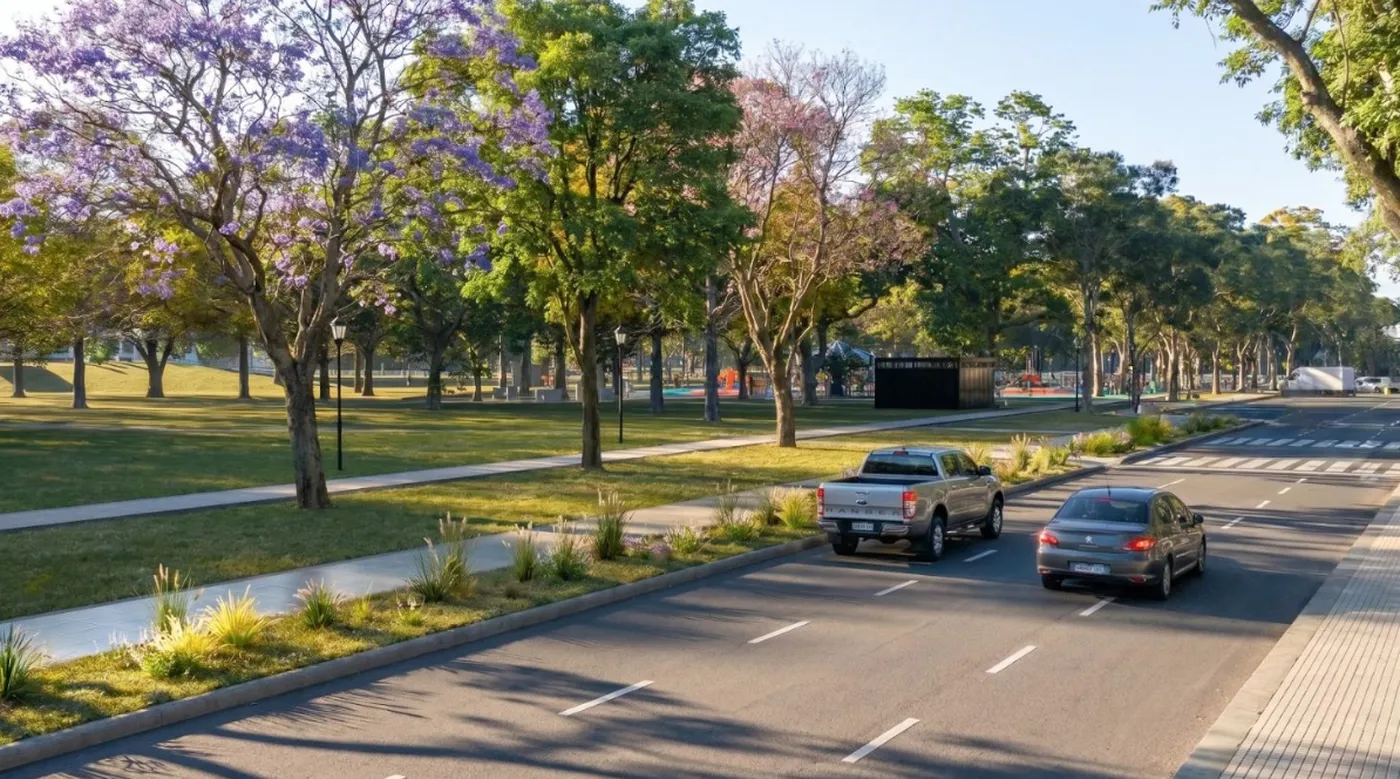
The Municipality of La Plata announced that it will be the first city in the country to implement improved paving with recycled rubber and titanium dioxide. The initial experience will be developed over 200 meters of Parque Saavedra, as part of its expansion.
This type of road infrastructure is already mandatory in cities like Medellín and Madrid, and is used on highways in Brazil. Now, La Plata becomes a pioneer in Argentina.
Agreement with UTN
The project arises from an agreement with the National Technological University (UTN), which will provide technical advice. According to Gerardo Botasso, director of the Secretariat of Science, Technology, and Postgraduate Studies at UTN to the portal El Día:
- The pavement is resilient to climate change, as it helps mitigate the urban heat island.
- The incorporated titanium dioxide allows for absorbing part of the CO₂ and gas emissions from vehicles.
- The recycled rubber improves the anti-slip capacity by 40%, reduces the thickness of the asphalt layer from 5 to 3 cm, and shows fewer wear-related breaks.
Environmental and urban benefits
The use of recycled rubber in pavements offers multiple advantages:
- Reuse of polluting waste: in Argentina, about 150,000 tons of tires are discarded per year.
- Reduction of carbon footprint: decreases dependence on fossil fuels and virgin rubber.
- Circular economy: transforms waste into input for infrastructure.
- Greater road safety: better adhesion and lower risk of accidents.
- Mitigation of urban heat: the pavement absorbs less heat than traditional cement.
Uses of recycled rubber
The versatility of recycled rubber makes it a key material for various applications:
- Infrastructure and asphalt: more durable roads, less traffic noise, and lower maintenance costs.
- Sports and recreation: filling for artificial turf and athletic tracks.
- Safety areas: cushioning floors in playgrounds.
- Construction: acoustic and thermal insulation.
- Accessories and footwear: durable soles and urban furniture items.
- Agriculture and gardening: mulches that retain moisture and prevent weeds.
Impact on the city
The implementation in Parque Saavedra will not only improve circulation and reduce environmental impact but will also serve as a pilot project for future works in the city. If the results are positive, La Plata could become a national reference in the use of sustainable paving technologies.
Paving with recycled rubber and titanium dioxide in La Plata marks a milestone in Argentina’s urban and environmental innovation.
This project combines modern infrastructure, circular economy, and climate resilience, showing how cities can adapt to climate change and reduce their environmental impact while improving the quality of life for their inhabitants.



