



Although 70% of the Earth’s surface is covered by water, only 1% is suitable for human consumption, posing an urgent challenge. Faced with this reality, innovative solutions like ‘Water from Air’ emerge, a portable bottle printed in 3D that extracts water from the air without the need for electricity, designed for environments without access to safe sources.
Energy-free technology: how ‘Water from Air’ works
An autonomous system based on porous materials and natural condensation. Created by German designers Louisa Graupe and Julika Schwarz, the device uses a material called MOF (Metal-Organic Framework), specifically SHCP-10, capable of capturing water vapor even in low humidity environments.
Its operation is simple:
- Open the MOF compartment for an hour to absorb moisture.
- Then close the system, generating internal heat that condenses the vapor.
- Water droplets are collected in a lower tank, without the need for motors, batteries, or solar energy.
The result is naturally distilled water, ready to drink, although it may require remineralization in certain nutritional cases.
Accessible, modular, and scalable design
Visually, the device is simple and functional: transparent conical body, yellow handle, and blue tap, ideal for domestic use or outdoor activities. But its real value lies in its modularity: if a piece breaks, it can be reprinted in 3D, which reduces costs and facilitates maintenance.
Moreover, the design is scalable, allowing expanding its capacity to supply entire communities in vulnerable areas, making it a key tool against climate change and the global water crisis.
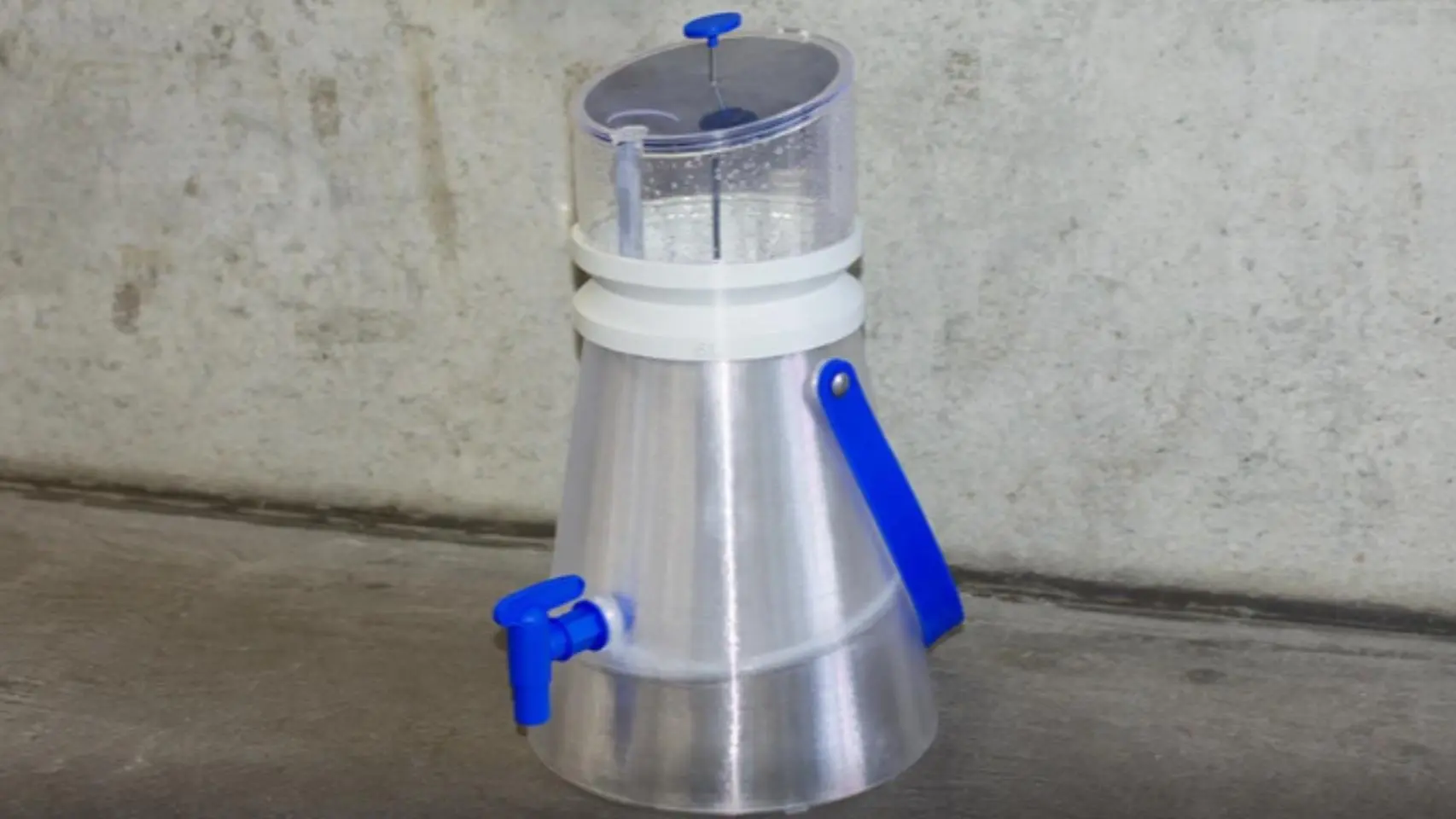
A prototype with a future vision
Although ‘Water from Air’ is still a concept in development, its potential impact is enormous. It produces up to 6 liters of drinking water daily under optimal conditions, without depending on energy infrastructure. This makes it a viable alternative for regions without access to safe water.
However, it faces some challenges:
- SHCP-10 material is not yet produced on a large scale, limiting its availability and potentially raising costs.
- Water production depends on ambient humidity, so its performance varies depending on the climate.
- The lack of minerals in distilled water may require remineralization to ensure its nutritional value.
Social innovation and purpose-driven design
The vision behind ‘Water from Air’ is clear: create an affordable, reproducible, and autonomous solution for those who need it most. According to the World Health Organization (WHO), more than 2.2 billion people lack access to safe water, and these types of technologies can make a difference.
As Schwarz emphasizes:
“We demonstrate that the idea of obtaining clean water from the air can become a reality to achieve lasting change in life, in times of climate change.”



