



The rapid expansion of electric vehicles poses an urgent dilemma: what to do with the batteries once they reach the end of their lifespan? Until recently, the debate revolved around lithium extraction, mainly concentrated in the “Lithium Triangle” of Argentina, Bolivia, and Chile. However, today the focus is also on how to recycle it efficiently and sustainably.
Traditional methods of lithium extraction from salars and open-pit mines have a significant environmental impact, with excessive water consumption and disruption of fragile ecosystems. Faced with this scenario, the reuse of depleted batteries emerges as a strategic alternative to reduce pressure on mining and move towards a circular economy.
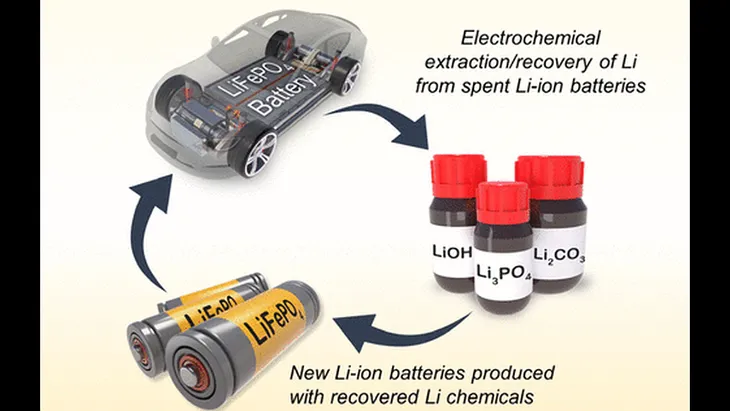
In this context, scientists from the University of Wisconsin–Madison have developed an electrochemical technique that allows the recovery of lithium from used lithium-iron-phosphate (LFP) batteries. This innovation is clean, scalable, and applicable to complex waste such as “black mass,” the crushed material obtained in recycling plants.
LFP batteries, although less energy-dense than other variants, stand out for their low cost, thermal stability, and lower toxicity. Their increasing popularity among large-scale manufacturers makes their recycling increasingly relevant for the sustainability of the automotive industry and waste reduction.
 Innovation in lithium recycling from electric vehicle batteries. Photo: Ámbito.
Benefits of lithium batteries in electric vehicles
Lithium is now one of the most valuable elements for the energy transition. The batteries containing it have enabled the mass adoption of electric vehicles thanks to their high storage capacity and long lifespan. Compared to fossil fuels, they represent a much less polluting alternative, as they reduce greenhouse gas emissions and dependence on oil.
Another benefit is the possibility of integrating them into renewable energy storage systems. Lithium batteries allow the storage of electricity generated by solar panels and wind turbines, balancing the supply and demand of clean energy on electric grids seeking to reduce their carbon footprint.
Furthermore, lithium batteries offer safety and reliability in their use. They are lighter than other options, require less maintenance, and have greater durability, resulting in less long-term waste. These attributes explain their central role in electric mobility, in technological devices, and in household and industrial energy storage.
 Innovation in lithium recycling from electric vehicle batteries. Photo: Ámbito.
A technology with a vision for the future
The new electrochemical process differs from current methods by not requiring extreme temperatures or large volumes of chemicals, making it more environmentally friendly. By focusing on LFP batteries, it offers a practical solution for a rapidly expanding market segment.
The initiative already has a prototype in development and the interest of major automakers. Furthermore, it complies with European regulations that, starting in 2031, will require a minimum percentage of recycled lithium in all new batteries. This regulation will compel the industry to adopt circular processes and accelerate investment in cleaner technologies.
The economic impact is also significant. With the recent volatility in lithium prices—which exceeded $11,000 per ton in August—having alternative sources of supply through recycling becomes strategic to stabilize markets and reduce dependence on intensive mining.
By integrating technological innovation, environmental benefits, and regulatory requirements, lithium recycling emerges as one of the most promising tools to support the global energy transition. More than waste, depleted batteries are a resource that can drive a sustainable future, where mobility and ecology advance hand in hand.



