



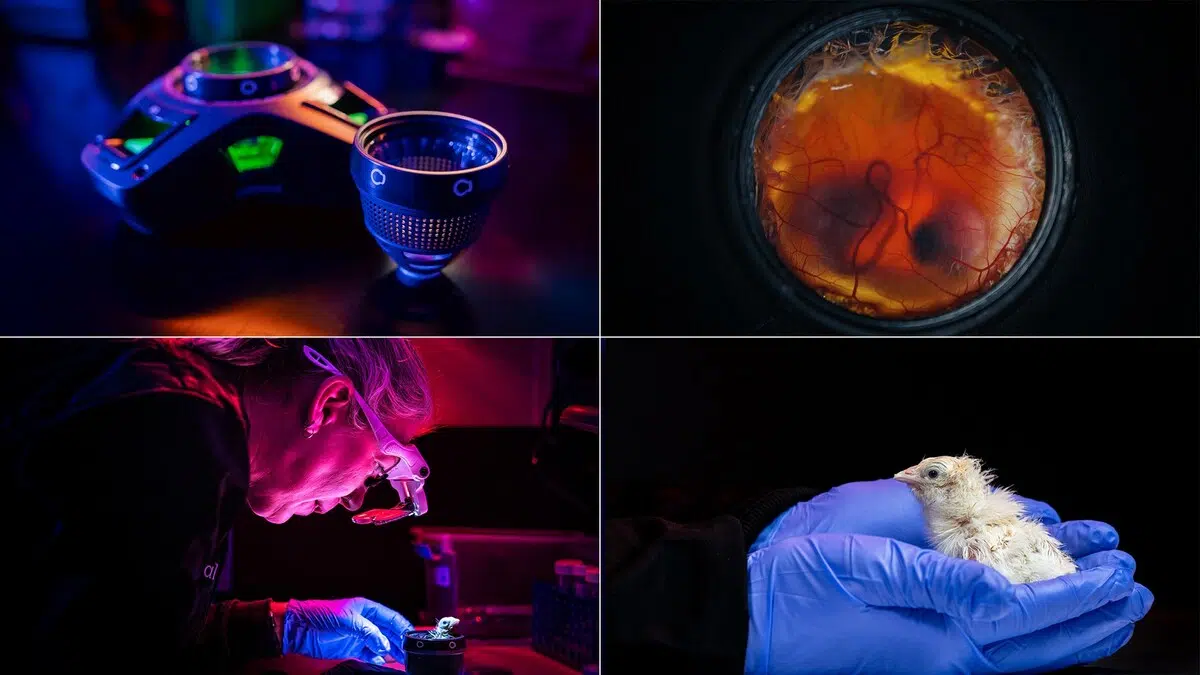
The American company Colossal Biosciences announced that it successfully incubated and raised 26 chicks using a 3D-printed artificial structure that mimics the function of an eggshell.
The experiment, considered a milestone in “de-extinction” research, opens new possibilities in animal reproduction, genetic conservation, and projects aimed at recreating extinct species.
How the system works
Researchers transferred fertilized eggs to a 3D-printed lattice structure, designed to replace the natural shell.
- Calcium supplements, essential for embryonic development, were added.
- Growth was monitored in real-time through imaging.
- Critical variables were precisely controlled: oxygen, humidity, and temperature.
Colossal’s CEO, Ben Lamm, explained: “We wanted to build something that nature has successfully developed and make it more scalable and efficient.”
Potential applications
The technology could be scaled to work with large birds, such as the extinct giant moa of New Zealand, and serve as a tool in conservation and assisted reproduction projects.
Criticism and scientific caution
Independent specialists urged caution regarding the real scope of the experiment:
- Evolutionary biologist Vincent Lynch pointed out that it is more of an “artificial shell” than a complete egg, as other biological components are still present.
- He warned that it could be useful for creating genetically modified birds, but it does not imply “resurrecting” extinct species.
Company background
Colossal had already sparked debate with projects such as:
- Genetically modified mice with fur inspired by the woolly mammoth.
- Genetically altered puppies to resemble the dire wolf.
These developments have reignited scientific and ethical discussions about de-extinction.
Ethical and environmental dilemmas
Bioethicist Arthur Caplan raised questions about the welfare and adaptation of recreated organisms in modern ecosystems, altered by climate change and human activity.
- Where could these creatures live?
- How to ensure their survival and well-being?
Applications in current conservation
Beyond de-extinction, some researchers believe this technology could be more useful for:
- Improving reproduction techniques in threatened species.
- Preserving the genetic diversity of at-risk populations.
- Developing new tools for animal conservation.
The 3D-printed “artificial egg” represents a remarkable advancement in biotechnology, capable of paving the way for both the conservation of current species and the controversial idea of recreating extinct animals.
Although the scientific and ethical debate continues, the experiment demonstrates how genetic engineering continues to expand the boundaries of what is possible.



