



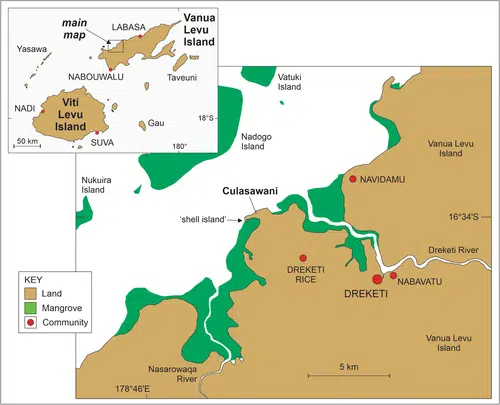
Off the coast of Vanua Levu, in the Fiji archipelago, a group of scientists identified an island with an unusual origin. Consequently, the discovery provides new insights into the human interaction with the environment.
At first glance, the islet seemed like just another piece of land within the coastal ecosystem. However, its composition revealed a different story.
The soil is not made up of common sediments. Therefore, it is composed of 90% compacted mollusk shell fragments.
A landscape built over 1,200 years
The study published in Geoarchaeology indicates that this formation developed over approximately 1,200 years. In this sense, human communities used the site to process shellfish.
Furthermore, it was not a permanent settlement. Therefore, it functioned as a specific space for coastal activity.
According to the team led by Patrick D. Nunn, the accumulation was constant. Consequently, the waste transformed into a solid structure.
Likewise, dating places the origin around the year 760. Thus, it is linked to Pacific cultures associated with the Lapita peoples.
From waste to ecosystem: a natural transformation
Over time, the accumulation of shells altered the environment. Consequently, conditions were created for the development of vegetation.
The mangroves began to grow on this artificial base. Additionally, they stabilized the sediment and consolidated the land.
Likewise, the island acquired characteristics typical of a functional ecosystem. Therefore, it went from being a waste deposit to a habitat.
Thus, nature integrated the human footprint. In this way, a hybrid landscape between culture and environment was configured.
Ecological consequences of historical human intervention
The case demonstrates that environmental transformation is not recent. Firstly, it shows that human activities impact even unintentionally.
Moreover, prolonged waste accumulation can alter ecosystems. Consequently, it modifies natural dynamics.
However, it also shows the environment’s capacity for adaptation. Therefore, some ecosystems manage to integrate into new conditions.
Likewise, this type of process can influence local biodiversity. Thus, new ecological balances are generated.

Midden island: when waste becomes territory
The so-called midden island are formations created from the prolonged accumulation of organic waste, mainly mollusk shells. Consequently, these deposits, generated by everyday human activities such as eating, end up consolidating into structures similar to small islands.
Additionally, these spaces were not permanent settlements but specific areas where communities processed marine resources. Therefore, the repetition of this practice over centuries allowed the remains to compact and gave rise to a new type of landscape.
Likewise, from an ecological and archaeological perspective, these islands function as environmental archives. Thus, they reveal how the interaction between culture and nature can transform the territory gradually, even without conscious planning.
Evidence of everyday impact on the planet
This discovery invites us to rethink the relationship between humanity and nature. Consequently, it shows that simple actions can transform the environment.
Moreover, it highlights that the human impact did not begin with industrialization. Therefore, it has much older roots.
Likewise, it shows that waste can become landscape. Thus, the concept of environmental intervention is redefined.
Ultimately, this island is a testimony of the past. Thus, it reminds us that even everyday gestures can leave lasting marks on the planet.



