



In the mountain valley connecting Esquel with Trevelin, beekeeping has become a key activity for the regional biodiversity. There, beekeeper Carlos Juan manages between 600 and 700 beehives with his partner Huenu Mastronardi, producing honey under the Valle Andino brand.
Unlike many local producers who maintain few apiaries, the couple lives exclusively from the beekeeping activity. However, as is the case in much of the world, the hives face a persistent threat: the Varroa destructor mite.
This parasite feeds on bees, weakens colonies, and can lead to the total loss of hives. Faced with this global health challenge, scientists in Patagonia have begun to research natural solutions to protect these essential insects for ecosystems.
An alliance between science and beekeeping
The search for an alternative began at the Laboratory of Research in Evolution and Biodiversity of the National University of Patagonia San Juan Bosco. There, a team of specialists in bee health has been working for years on the study of pests affecting hives.
The research is led by acarologist Susana Rizzuto, along with scientists Rosa Manzo, Carolina Amaturi, and Brenda Freeman. The group began working on developing natural tools to combat varroa, a health problem affecting global beekeeping.
Bees play a fundamental role in the pollination of crops and in the conservation of ecosystems. For this reason, the loss of colonies represents a growing concern for food production and biodiversity.
BioVar Patagonia: a natural alternative for hives
After several years of research, the team managed to formulate a bioproduct called BioVar Patagonia. The compound is based on essential oils obtained from aromatic plants of the region, such as thyme and lavandin.
The first tests began in the laboratory in 2017, where its efficacy against the mite and its safety for bees were evaluated. Subsequently, the project moved to a new stage: testing how the product works in real production conditions.
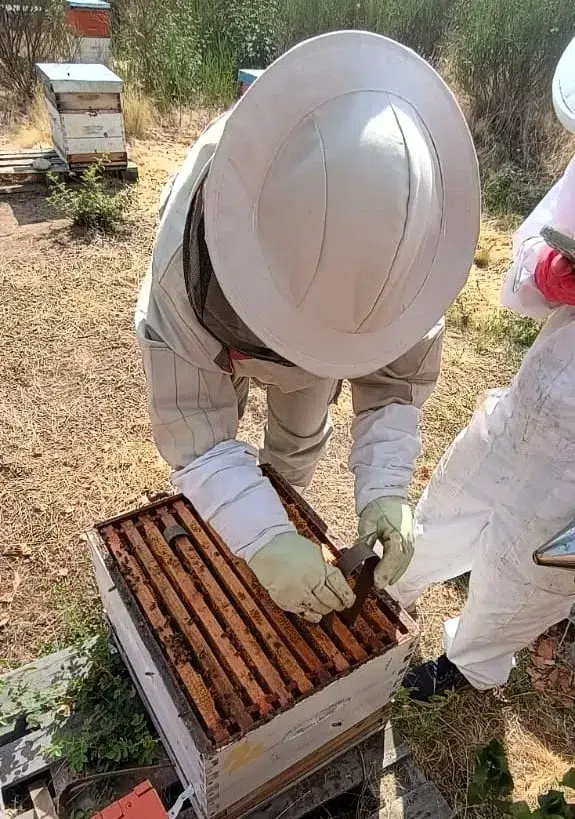
To achieve this, the researchers needed active hives to conduct the experimental trials. At that moment, the collaboration of regional beekeepers emerged, including mountain producer Carlos Juan.
The tests are conducted between February and March in various Patagonian apiaries, just before the annual closure of the hives.

The benefits behind this initiative
The development of natural solutions for controlling bee pests can generate significant environmental benefits. Firstly, it allows for reducing the dependency on chemical products typically used to combat varroa.
Moreover, these chemical treatments can lose efficacy over time due to the resistance developed by the parasites. Conversely, bioproducts based on natural compounds aim to offer more sustainable alternatives for the health management of hives.
They also help protect the health of bees, insects essential for the pollination of numerous crops. It is estimated that a large part of the world’s agricultural production depends directly or indirectly on these pollinators.
Therefore, scientific initiatives like BioVar Patagonia not only benefit beekeepers but also biodiversity and food security.
A project that unites research and production
The experience also reflects the value of cooperation between science and local producers. Beekeepers contribute their knowledge of the territory and facilitate access to hives for conducting trials.
Meanwhile, public universities develop tools based on applied scientific research.
If the results continue to be positive, BioVar Patagonia could become a new strategy to combat varroa.
In this way, Patagonian science would contribute to protecting one of the invisible pillars of ecosystems: bees and their silent work in the pollination of nature.



